
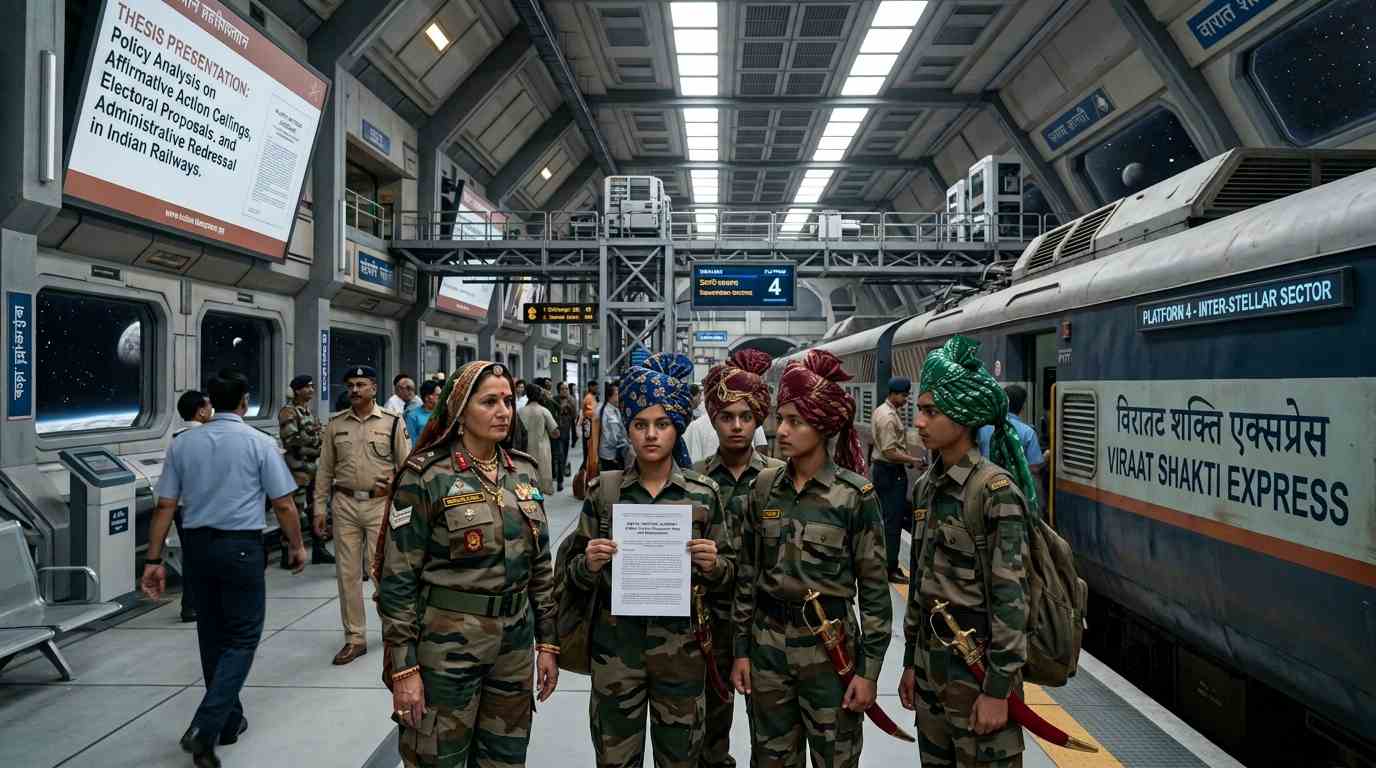
Abstract
Indian Railways serves as the physical backbone of national integration, freight logistics, and passenger safety. This research paper evaluates the historic shift, contemporary socio-economic status, and strategic pathway for the Rajput community—specifically its youth—in entering Indian Railways across Groups A, B, C, and D. By adopting modern technology, transparent merit-based strategies, and a strong sense of civic duty toward passenger safety (especially women’s security), Rajput students can overcome historical under-representation in state and central public service sectors.
1. Socio-Economic Necessity & Strategic Importance of Railway Jobs for Rajput Youth
Historically rooted in defense, governance, and rural agrarian pursuits, large segments of the Rajput community experienced structural shifts following post-independence land reforms and administrative reorganization.
+- +-----------------------------------------------------------------------------------+
| SOCIO-ECONOMIC REALIGNMENT MATRIX |
+-----------------------------------------------------------------------------------+
| Past Role : Agrarian Holdings & Local Feudal Administration |
| Current Need: Secure Public Employment, Technical & Managerial Roles |
| Target Sector: Indian Railways (Group A Officers down to Group D Trackmen) |
+-----------------------------------------------------------------------------------+
–———————————————————————————+
| SOCIO-ECONOMIC REALIGNMENT MATRIX |
+———————————————————————————–+
+———————————————————————————–+
Strategic Benefits of Railway Employment
- Economic Stability & Long-Term Security: Rail services offer permanent central government employment, structured pay commissions, health coverage (CGHS/Railway Hospitals), and post-retirement social security.
- Pan-India Mobility: Serving across 17 Zonal Railways and 70+ Divisions facilitates national integration and establishing deep roots in diverse states.
- Public Leadership: Roles in the Railway Protection Force (RPF) and operational management directly position candidates to protect citizens, safeguard infrastructure, and serve rural and urban commuters alike.
2. Demographic Analysis: Representation in Railway Cadres
Current Workforce Trends (Group 1 to Group 4)
While exact caste-based census data within central public sector undertakings (PSUs) is not published separately for unreserved sub-groups, observational and field research indicates that the proportion of Rajput students across Railway Groups A, B, C, and D remains disproportionately low relative to their total estimated population (~10 Crore nationwide).
Group A (UPSC - IRTS, IRSE, IRAS): < 3% Estimated Representation
Group B (Promotional Cadre) : < 2.5% Estimated Representation
Group C (NTPC, JE, SSE, and Station Master): ~4% Estimated Representation
Group D (Track Maintainer, Assistant): ~5% Estimated Representation
UPSC – IRTS, IRSE, IRAS: < 3% Estimated Representation
Group B (Promotional Cadre) : < 2.5% Estimated Representation
Group D (Track Maintainer, Assistant): ~5% Estimated Representation
Addressing the Demand for Proportional Representation
Community forums and youth representatives argue that to achieve socio-economic parity across public sector institutions, structured participation in open competitive recruitment is necessary. Achieving a strong, merit-driven candidate pool from the ~20 lakh educated, defence-oriented Rajput youth ensures that the community contributes its fair share to national infrastructure development.
3. Post Hierarchy Matrix: From Railway Board / Ministry to Entry Level
Indian Railways categorizes its workforce into four main operational groups:
[Group A: UPSC Cadre] ──▶ [Group B: Gazetted Officers]──▶ [Group C: Technical/NTPC]──▶ [Group D: Support Staff]
[Group A: UPSC Cadre] ──▶ [Group B: Gazetted Officers] ──▶ [Group C: Technical/NTPC] ──▶ [Group D: Support Staff]
| Cadre / Group | Typical Posts & Designations | Minimum Qualification | Age Limit (General Unreserved) | Selection Authority |
| Group A | IRTS (Traffic), IRSE (Civil), IRAS (Accounts), IRPS (Personnel), RPF Commandants | Graduate Degree / BE / B.Tech | 21 – 32 Years | UPSC (Civil Services & Engineering Services) |
| Group B | Assistant Commercial Manager, Assistant Engineer, Section Officer | Internal Promotion from Group C | Service Experience Based | Departmental Promotion Committee (DPC) / LDCE |
| Group C (Technical) | Junior Engineer (JE), Senior Section Engineer (SSE), Loco Pilot (ALP), Technicians | Diploma / BE / B.Tech / ITI | 18 – 33 / 36 Years | Railway Recruitment Board (RRB) |
| Group C (NTPC) | Station Master, Goods Guard, Commercial Apprentice, Senior Clerk, Ticket Collector (TC) | Graduate Degree / 10+2 | 18 – 33 / 36 Years | Railway Recruitment Board (RRB) |
| Group D (Level-1) | Track Maintainer Grade-IV, Assistant Pointsman, Hospital Attendant, Peon/Office Attendant | 10th Pass OR ITI | 18 – 33 / 36 Years | Railway Recruitment Cell (RRC) |
4. Reservation Framework, Equity, and Policy Analysis
Current Constitutional Reservation Structure in Central Jobs
+———————————————————————————–+
| 50% RESERVATION CAP & CATEGORIES |
+-----------------------------------------------------------------------------------+
| 50% RESERVATION CAP & CATEGORIES |
+-----------------------------------------------------------------------------------+
| Scheduled Castes (SC) : 15.0% |
| Scheduled Tribes (ST) : 7.5% |
| Other Backward Classes (OBC) : 27.0% |
| Economically Weaker Section (EWS): 10.0% (Within General Quota) |
| Total Reserved Quota : ~59.5% (Includes 10% EWS under 103rd Amendment) |
+-----------------------------------------------------------------------------------+
+———————————————————————————–+
+———————————————————————————–+
Analysis of the 50% Ceiling and Community Perspectives
- Constitutional Precedent: The Supreme Court of India in the landmark Indra Sawhney (1992) judgment capped reservations at 50% to balance affirmative action with open merit. The introduction of the 10% Economically Weaker Section (EWS) quota under the 103rd Constitutional Amendment opened structured reservations for low-income families in general/unreserved categories.
- Justification & Open Competition: Many Rajput candidates who do not qualify under EWS income caps must compete in the Unreserved (UR) general merit pool. Rather than relying solely on reservation expansions, the community’s long-term success depends on academic competitiveness, technical mastery, and organized preparation.
- Addressing Concession and Grievance Issues: Concerns regarding ticket concessions or administrative delays by railway staff are governed by statutory Indian Railways rules. To address any perceived bias, candidates and commuters should utilize formal redressal mechanisms (such as RailMadad, CPGRAMS, or representations to elected MPs/MLAs) rather than informal disputes, ensuring rights are enforced lawfully.
5. Hidden & Specialized Career Opportunities in Indian Railways
Beyond standard NTPC and Group D recruitment drives, several specialized and lesser-known entry points exist:
- Railway Protection Special Force (RPSF) & RPF Sub-Inspector: Direct recruitment for physically disciplined candidates via central notifications.
- Sports Quota Recruitment: Openings for athletic and combat-sport athletes across Zonal Headquarters.
- Cultural Quota & Scout and Guide Quota: Level 2 and Level 3 posts reserved for certified candidates in scouts, guides, and cultural arts.
- Railway Public Sector Undertakings (PSUs): Independent recruitments conducted by:
- IRCTC: Tourism, Catering, and Digital IT services.
- RITES Ltd. & IRCON: Engineering, infrastructure, and international logistics consulting.
- RVNL (Rail Vikas Nigam Limited): Mega project execution.
- CRIS (Centre for Railway Information Systems): Software architecture, Database Administration, and AI-driven traffic systems.
6. Comprehensive Step-by-Step Application to Joining Process
[Phase 1: OTR & Notification] ──▶ [Phase 2: CBT-1 Screening] ──▶ [Phase 3: CBT-2 / Technical] ──▶ [Phase 4: PET / Skill Test] ──▶ [h[Phase 1: OTR & Notification] ──▶ [Phase 2: CBT-1 Screening]──▶ [Phase 3: CBT-2 / Technical]──▶ [Phase 4: PET / Skill Test]──▶ [Phase 5: Medical & DV]
5: Medical & DV]
Step 1: One-Time Registration (OTR) and Online Application
- Monitor centralized recruitment portals (rrbapply.gov.in / rrb.indianrailways.gov.in).
- Create a single candidate account using Aadhaar, verified mobile number, and email.
Step 2: Computer Based Test Phase 1 (CBT-1)
- Screening Stage: Objective test covering Mathematics, General Intelligence & Reasoning, General Science, and Current Affairs.
- Qualifying Threshold: Securing top-tier percentile ranks to clear zone-wise cutoffs.
Step 3: Computer Based Test Phase 2 (CBT-2) & Specialized Papers
- In-depth paper covering domain-specific technical subjects (for JE/SSE/Loco Pilot) or advanced aptitude and general awareness (for NTPC posts).
Step 4: Physical Efficiency Test (PET) & Skill Assessments
- For Group D / RPF: 1000m running within specified time limits, weight lifting/carrying endurance tests.
- For Typist / Clerk Roles: Computer typing tests (30 WPM English / 25 WPM Hindi).
- For Loco Pilots & Station Masters: Computer Based Aptitude Test (CBAT / Psycho Test).
Step 5: Document Verification (DV) & Stringent Medical Examination
- Verification of 10th/12th/Degree certificates, caste/EWS proofs, and identity documents.
- Strict medical classification (A-1, A-2, B-1, etc.), including vision acuity tests (without glass corrections for operational roles).
7. Official Zonal Railway Recruitment Websites
To apply for official postings, candidates must utilize authorized domain portals:
| Zonal Railway / Recruitment Board | Headquarters City | Official Portal URL |
| Central Railway (CR) | Mumbai | https://rrccr.com |
| Northern Railway (NR) | New Delhi | https://rrcnr.org |
| North Central Railway (NCR) | Prayagraj (Allahabad) | https://rrcald.org |
| North Western Railway (NWR) | Jaipur | https://nwr.indianrailways.gov.in |
| Eastern Railway (ER) | Kolkata | https://rrcer.com |
| East Central Railway (ECR) | Hajipur | https://rrcecr.gov.in |
| Western Railway (WR) | Mumbai | https://rrc-wr.com |
| West Central Railway (WCR) | Jabalpur | https://wcr.indianrailways.gov.in |
| Southern Railway (SR) | Chennai | https://rrcmas.in |
| South Central Railway (SCR) | Secunderabad | https://scr.indianrailways.gov.in |
| Central RRB Portal | India-wide | https://rrb.indianrailways.gov.in |
8. Integration of Modern AI Tools and Advanced Study Methodologies
To secure top ranks in highly competitive RRB exams, candidates should incorporate modern AI and technology-driven study techniques:
[Official RRB Syllabus] ➔ [AI Prompting & Topic Extraction] ➔ [Spaced Repetition Flashcards] ➔ [Automated Mock Analysis]
- AI-Driven Mock Analysis: Use AI tools to categorize weak areas in CBT test series (e.g., identifying speed bottlenecks in algebra or chemistry concepts).
- Automated PYQ Breakdown: Use natural language processing tools to group ten years of RRB NTPC / JE question papers into subject-wise micro-topics.
- Data Science Pipelines: Track revision cycles, daily practice accuracy, and sectional mock scores using custom spreadsheets (Google Sheets / Excel) or python-based analytics tools (pandas, matplotlib).
- Adaptive Learning: Utilize digital flashcards (Anki) powered by AI summary tools for rapid memory retention of Railway budget numbers, static general knowledge, and operational rules.
9. Social Duty: Moral Guardianship and Women’s Protection in Public Transit
A core value for Rajput youth entering public services is the commitment to public safety, chivalry (dharma), and civic responsibility.
[Official RRB Syllabus] ➔ [AI Prompting & Topic Extraction] ➔ [Spaced Repetition Flashcards] ➔ [Automated Mock Analysis]
- Preventing Crime in Transit: RPF personnel and railway staff play a direct role in securing women’s coaches, responding to helpline alerts (139 / RailMadad), and preventing harassment on trains and platforms.
- Building Safe Public Spaces: Having disciplined, ethically driven youth on duty fosters a safer transit environment for women, elderly passengers, and vulnerable travelers across all regions, languages, and communities.
- Institutional Ethics: Upholding absolute impartiality, constitutional neutrality, and zero tolerance for discrimination or misconduct across all passenger services.
10. Conclusion & Strategic Action Plan
Socio-economic empowerment for Rajput students requires transitioning from traditional mindsets to modern public administration, technology, and civil services.
Action Steps for Candidates:
- Immediate Registration: Complete One-Time Registration (OTR) on centralized RRB/RRC portals.
- Targeted Preparation: Balance general quantitative aptitude with technical qualifications (ITI, Diploma, Degree).
- Leverage Modern Tools: Use AI-assisted learning platforms to streamline preparation and master CBT exam patterns.
- Civic Engagement: Engage constructively with community leaders, elected representatives (MPs/MLAs), and official grievance portals to advocate for transparent recruitment, equal opportunity, and educational support centers.
Question: How does Indian Railways address concerns regarding fraudulent reservation claims and ensure transparency in recruitment and promotional rosters?
Answer: Indian Railways enforces strict document verification procedures, mandating that candidates present valid central category certificates from authorized issuing officers before final appointment. Any submission of fraudulent certificates or procedural irregularities undergoes formal investigation by vigilance authorities, leading to service termination, lifetime recruitment debarment, and legal prosecution. Additionally, public reservation rosters and recruitment processes are maintained under statutory guidelines to guarantee fair, merit-based selection across unreserved and reserved vacancies. There is problem in Hindu SC/ST Job other Crypto SC/ST take their Job fare enquiry required no any loop hole justified.
