
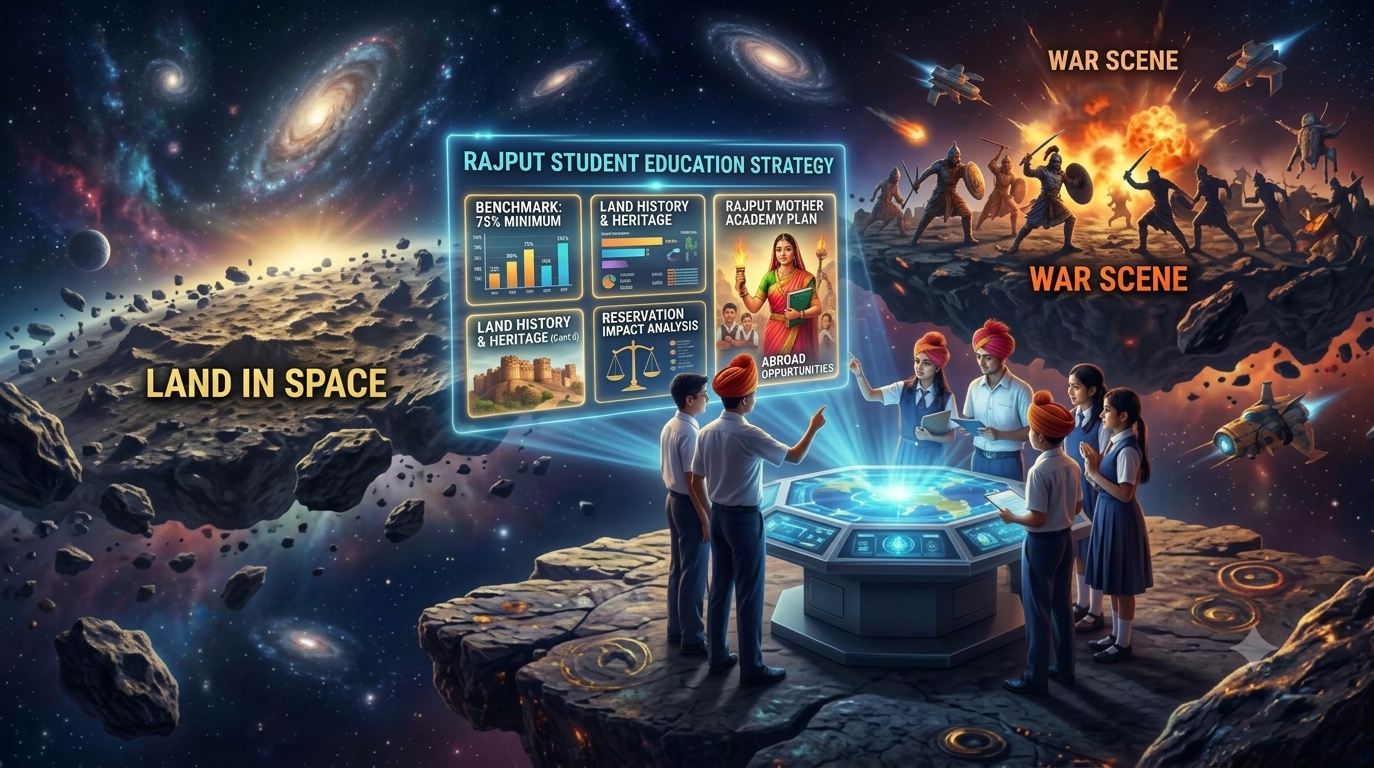
Section1: Rajput Students Informations
Imperative Academic Target: The Mandatory 75% Benchmark
For every Rajput student enrolled in Class 10 and Class 12 board examinations, securing a minimum aggregate score of 75% is an absolute operational requirement. This threshold is not a soft suggestion, nor is it a personal luxury; it is the absolute baseline required to navigate modern higher education structures, competitive entry criteria, and corporate employment thresholds.
In the contemporary socioeconomic landscape, academic scores serve as the primary screening mechanism. A score below 75% immediately restricts access to top-tier state and central universities, disqualifies candidates from critical merit-based private scholarships, and closes off international academic pathways. Modern institutions utilize automated screening algorithms that filter out applications falling beneath strict percentile marks long before a human reviewer evaluates an applicant’s individual talent or character.
Therefore, 10th and 12th class students must treat the 75% mark as the absolute floor of their academic efforts. Achieving this target demands rigorous daily scheduling, strict examination preparation, subject-matter mastery, and a complete removal of trivial distractions during these foundational academic years.
Historical Duty: Defense, Public Security, and Administrative Stewardship
To understand the modern imperative for intellectual rigor, Rajput youth must analyze their historical legacy through an analytical and functional lens rather than through passive nostalgia.
Historically, the Rajput community performed structural state functions that were essential to society:
- Defense and Territorial Integrity: Direct engagement in border security, military command, and tactical warfare.
- Public Security and Law Enforcement: Maintaining civil order, protecting trade corridors, and enforcing local justice within sovereign territories.
- Revenue Management and Tax Collection: Managing rural and agrarian taxation systems, maintaining grain reserves, and funding state-level public works.
- Social Stewardship: Protecting civic infrastructure, religious institutions, trade routes, and agricultural populations during periods of geopolitical volatility.
These systemic duties required primary specialization in martial discipline, statecraft, resource management, and administrative command. While elite education in classics, politics, philosophy, law, and economics was consistently sustained among ruling lineages and administrative elites, the broader population was organized around military readiness and territorial governance. Academic specialization as it is defined today—standardized examinations, institutional degrees, and corporate professionalization—was secondary to the existential demand for state defense and public administration.
Today, the nature of power, governance, and survival has shifted permanently from territorial defense to intellectual capital, technological proficiency, regulatory mastery, and financial control. The historical duty of public stewardship remains, but its medium has changed. The modern battlefield exists within corporate boardrooms, technical laboratories, administrative courts, and capital markets. To fulfill the historical mandate of social stewardship, Rajput youth must adapt by acquiring elite domain expertise, high academic scores, and advanced quantitative capabilities.
Post-Independence Restructuring and Structural Land Loss
The economic base of the Rajput community was historically tied to land ownership and agricultural revenue management. Following Indian independence, a series of state-directed structural land reforms fundamentally transformed this economic foundation. Modern Rajput students must clearly understand the mechanics of the 1st Land Ceiling Act and the 2nd Land Ceiling Act to comprehend their current economic positioning.
The 1st and 2nd Land Ceiling Acts
Through successive land ceiling legislations passed across various Indian states between 1950 and 1972, the state set statutory upper limits on the maximum acreage of agricultural and real estate property an individual or joint family could legally hold.
- Expropriation of Surplus Land: Land held by Rajput families above the legislated ceiling limits was declared “surplus” and expropriated by state governments.
- Transition to Government Ownership: Millions of acres of privately owned, ancestral land were directly converted into public property, state reserves, or redistributed under government land schemes.
- Infrastructure Development on Expropriated Property: The physical infrastructure of modern rural and semi-urban India was largely constructed upon land taken through these ceiling acts. This included:
- Public Facilities: Schools, government hospitals, panchayat bhavans, and police stations.
- Civic Spaces: Community centers, playgrounds, and public parks.
- Agricultural Infrastructure: Primary irrigation canals, secondary distribution channels (nalis), feeder roads, and village threshing grounds (khaliyans).
While these land reforms served the state’s macro-structural objectives of nation-building, rural development, and asset redistribution, their direct economic consequence was the severe contraction of generational wealth, land holdings, and agrarian income streams for traditional land-owning families.
The Modern Economic Reality
The structural loss of land meant that the historical safety net of agricultural revenue was permanently dissolved. Today, land can no longer serve as the primary source of economic security or generational mobility for the vast majority of Rajput families. Agrarian holdings have been fragmented through generational division, leaving small, economically unviable plots.
Consequently, relying on traditional landholdings for long-term economic stability is an obsolete strategy. Modern Rajput students must realize that intellectual capital has replaced land as the primary asset class. The transition from landed security to professional competence is absolute. Acquiring high-value skills, secure technical employment, and independent financial capability through academic excellence is the only viable pathway to sustaining family stability and institutional influence.
Section 2: Rajput Research
Quantitative Analysis of General Category Admissions in Competitive Entrance Examinations
An examination of the structural allocation of seats in higher education reveals the precise competitive constraints faced by general-category candidates, including Rajput students, in national entrance examinations such as the Joint Entrance Examination (JEE Main/Advanced) and the National Eligibility cum Entrance Test (NEET).
Statutory Quota Allocation Structure
Under current statutory frameworks governed by central and state legislations, seat capacity in public higher education institutions (IITs, NITs, AIIMS, and state medical colleges) is allocated according to strict quota categories.
| Category | Statutory Reservation Percentage |
| Scheduled Castes (SC) | 15.0% |
| Scheduled Tribes (ST) | 7.5% |
| Other Backward Classes (OBC-NCL) | 27.0% |
| Economically Weaker Sections (EWS)* | 10.0% |
| Total Reserved Capacity | 59.5% |
| Open Competition / Unreserved (UR) | 40.5% |
*Note: EWS reservation applies exclusively to eligible general category candidates meeting strict income and asset criteria.
Admission Dynamics and Percentile Requirements
Because 59.5% of seats are categorically set aside, candidates competing within the Unreserved (UR) non-EWS pool are restricted to approximately 40.5% of the total institutional capacity. However, because the Unreserved pool is open to all categories purely on merit rankings, the actual effective seat competition for general-category students is even tighter.Total Institutional Seat Capacity: [====================] 100%
Reserved Allocations (SC/ST/OBC/EWS): [============ ] 59.5%
Open Unreserved Competition Pool: [ ========] 40.5%
To secure a seat in top-tier disciplines (such as Computer Science Engineering, Electronics, or MBBS in primary institutes), a general-category candidate must achieve high relative ranks:
- JEE Advanced (IIT Allocation): Out of approximately 250,000 qualified test-takers competing for around 17,000 total seats, the unreserved seat pool for core disciplines requires a candidate to secure a rank within the top 1.5% to 2.5% of all candidates nationwide.
- NEET-UG (Medical Allocation): With over 2,000,000 applicants competing for approximately 55,000 government MBBS seats, an unreserved candidate must secure a score typically exceeding the 98.5th percentile to gain admission to a government medical college under the All-India Quota (AIQ).
This quantitative reality proves that standard effort yields zero margin of safety for general-category applicants. For a Rajput student, achieving a “passing mark” or average percentile guarantees exclusion from state-subsidized technical and medical education. Performance must be optimized for top-tier competitive percentile ranks.
Economic Analysis of Higher Education Financing and Cross-Subsidization
A rigorous examination of university financial models illustrates the asymmetric burden placed on general-category and full-fee-paying students in both private and self-financed public higher education institutions.+———————————————————————–+
| FINANCIAL FLOW MODEL |
+———————————————————————–+
| General Category / Full-Fee Payers |
| (Pay standard / premium tuition, development fees, infrastructure) |
+———————————————————————–+
|
v
+———————————————————————–+
| INSTITUTIONAL TREASURY |
+———————————————————————–+
| |
v v
+—————————–+ +——————————-+
| Institutional Maintenance | | Reserved Category / |
| & Administrative Salaries | | Scholarship Cross-Subsidies |
+—————————–+ +——————————-+
Fee Structure Realities and Institutional Revenue
In self-financed private universities, engineering institutes, and professional colleges, tuition fees are structured to cover total operational expenses, faculty payroll, overheads, capital expenditures, and institutional expansion. General category students:
- Pay 100% of the prescribed tuition, laboratory, and development fees without direct statutory fee-waivers or state-reimbursement vouchers available to reserved categories.
- Directly cross-subsidize institutional operations, research facilities, and administrative overhead through higher net out-of-pocket tuition contributions.
Macro-Economic Contribution to Public Infrastructure
Tax revenues collected from general category households—through direct income taxes, capital gains taxes, GST, and property taxes—form a substantial part of the government treasury. These public funds directly finance state and central university grants, fund public sector salaries, and maintain government research laboratories.
Consequently, general category families contribute twice to the higher education ecosystem: first, as taxpayers funding the state machinery and public institutions, and second, as full-fee payers in private professional institutions when state quota limitations restrict their access to public seats. Understanding this financial reality underscores the necessity for absolute fiscal efficiency, smart educational investments, and economic self-reliance.
The Strategic Framework of the Rajput Mother Academy
To address the combined challenges of restricted state-subsidized seats, high private educational costs, and shifting economic paradigms, the community requires an independent academic model: The Rajput Mother Academy.
The operational philosophy of the Rajput Mother Academy is defined by the strategic doctrine: “Our fees, our college, our knowledge.”+———————————————————————–+
| RAJPUT MOTHER ACADEMY |
| Strategic Educational Framework |
+———————————————————————–+
|
+—————————+—————————+
| | |
v v v
+——————+ +——————-+ +—————-+
| DOMESTIC & INT’L| | INDEPENDENT PHYSICAL| | SCHOLARSHIP & |
| UNIVERSITY | | EDUCATIONAL | | ENDOWMENT |
| PARTNERSHIPS | | INFRASTRUCTURE | | CAPITAL |
+——————+ +——————-+ +—————-+
Strategic Objectives of the Academy
- Institutional Partnerships and Academic Tie-Ups:
- Forming direct institutional alliances with premier domestic private universities and accredited international institutions.
- Negotiating cohort-based fee structures, merit-based tuition waivers, and direct admission pathways for qualified Rajput students who meet rigorous academic benchmarks (e.g., the 75%+ threshold).
- Building Independent Educational Infrastructure:
- Establishing dedicated, self-sustaining preparatory academies, technical training centers, and research institutes funded through community capital, philanthropic endowments, and institutional fees.
- Directing internal community resources toward building quality educational facilities, ensuring that educational investments directly fund high-grade faculty, modern laboratory infrastructure, and advanced learning technologies for community youth.
- Capital Efficiency and Educational Autonomy:
- By consolidating tuition fees within affiliated, high-standard institutions, the community retains economic leverage, ensuring that student fees purchase top-tier technical education, industry-aligned skill sets, and global degree mobility rather than administrative overhead.
Academic Integrity Mandate: Mastery Over Synthetic Shortcuts
The Rajput Mother Academy framework strictly enforces a zero-tolerance policy against academic shortcuts, fraudulent certifications, exam leakage networks, and synthetic assistance tools.ACADEMIC INTEGRITY MATRIX
[Rigorous Problem-Solving] —> [True Domain Mastery] —> [Sustainable Career Leadership]
[Shortcuts & Malpractice] —> [Structural Deficit] —> [Systemic Failure]
Principles of Academic Rigor
- True Domain Mastery: Students must build fundamental competencies in mathematics, physical sciences, logical reasoning, legal synthesis, and quantitative economics. Synthetic aids, low-effort summaries, and unethical examination methods create an illusion of competence that breaks down immediately during professional technical evaluations and workplace execution.
- Problem-Solving Capability: The global market rewards individuals who can solve complex problems under high-pressure conditions. True analytical capability can only be developed through thousands of hours of deliberate practice, deep reading, core textbook analysis, and independent problem-solving.
- Systemic Reliability: A reputation for absolute integrity, technical excellence, and unyielding work ethic is the primary long-term asset of any professional community. Rajput youth are required to demonstrate uncompromised academic honesty in all board examinations, national entrance tests, and university assessments.
Unyielding Integrity and Hard Work: The Rajput Academic Creed
Rajput students consistently dedicate themselves to relentless hard work whether studying in IITs, government medical colleges, private universities, or elite international institutions, striving to excel on pure merit alongside their peers. They firmly reject dishonest practices, refusing to rely on ChatGPT, high-tech gadgets, or examination shortcuts. Even if a strict adherence to ethical standards results in a lower rank on paper, Rajput students remain grounded in uncompromised honesty and self-respect. They understand that test scores can be influenced by luck or external circumstances, but true character and genuine mastery are far superior to inflated marks. By trusting in their own intellect and resilience, Rajput youth build a foundation of knowledge that no synthetic tool or temporary rank can ever replace.
SECTION 3: GOVT FAQS
Q1: Why must Rajput students achieve a minimum of 75% in 10th and 12th board exams?
Answer:
Achieving a minimum score of 75% in 10th and 12th board examinations is a strict structural necessity due to four main factors:
- Eligibility Criteria for Competitive Examinations: Major national examinations, technical universities, and central institutes enforce minimum percentage cutoffs (typically 75% aggregate or top 20 percentile in board exams) as an essential eligibility criterion for registration and counseling.
- Corporate and Institutional Screening: Top-tier recruitment firms, technology companies, and global postgraduate programs use automated filtering tools that instantly discard candidate profiles falling below the 75% threshold, regardless of secondary qualifications.
- Scholarship and Financial Aid Thresholds: Merit-based tuition fee waivers, institutional grants, and private academic sponsorships overwhelmingly require a sustained academic record of 75% or higher.
- Buffer Against Reservation Constraints: Given that general category seats are restricted to roughly 40.5% of total capacity in public institutions, a high board percentage serves as a crucial baseline indicator of discipline, academic rigor, and preparation for open-market competition.
Q2: What is the historical context of Rajput land ownership and government acquisition?
Answer:
Historically, land ownership among Rajputs was not merely private real estate; it was an administrative asset tied to state duties. Rajput lineages held and managed land to support regional governance, tax collection, public safety, and defense capabilities.
Following India’s independence, the state enacted structural land reforms designed to dismantle agrarian concentration and build public infrastructure. Through state acquisition programs and statutory land ceiling laws, vast tracts of privately owned Rajput land were transferred directly to state ownership.
This land was subsequently converted into essential public infrastructure, including municipal buildings, public schools, state highways, irrigation canals (nalis), and agricultural community land (khaliyans). While this process supported broader national development, it permanently altered the traditional economic foundation of the Rajput community, shifting the source of financial stability from inherited land to professional competence.
Q3: How do land ceiling laws affect the economic landscape of Rajput families today?
Answer:
Land ceiling laws (specifically the 1st and 2nd Land Ceiling Acts) capped the total acreage of land any family could legally own, expropriating all surplus holdings for public use and redistribution. Over subsequent generations, the remaining land holdings were further subdivided among heirs, leading to the following modern economic realities:
- Fragmentation of Holdings: The vast majority of modern Rajput agricultural land holdings have been reduced to small, fragmented parcels that are economically unviable for commercial agriculture.
- Erosion of Generational Capital: Land can no longer generate sufficient residual income to cover modern living costs, healthcare, and higher education expenses.
- Necessity of Professional Diversification: Reliance on land as a primary income source or financial safety net is no longer a viable strategy. Economic survival requires an immediate shift toward high-value professional skills, corporate employment, technical expertise, and independent business enterprises.
Q4: Should Rajput students participate in political rallies or active politics?
Answer:
No. Class 10th and 12th Rajput students must strictly abstain from participating in political rallies, party youth wings, street demonstrations, or active political campaigning.+————————————————————————-+
| COMMUNITY DIVISION OF LABOR |
+————————————————————————-+
| STUDENTS (10th & 12th) | RAJPUT MOTHER PARTY & LEADERSHIP |
| – 100% Focus on Academics | – Administrative Advocacy |
| – 75%+ Board Target | – Policy & Political Leadership |
| – Technical & Professional Skill| – Guided by “Rajput Smriti” |
+————————————————————————-+
Strategic Rationale
- Primary Task Allocation: The sole responsibility of students in Class 10 and 12 is academic excellence, technical mastery, and physical fitness. Engaging in street politics creates legal risks, physical safety hazards, and irreversible academic distraction.
- Institutional Division of Responsibility: Political leadership, administrative advocacy, legislative engagement, and policy representation are handled exclusively by the Rajput Mother Party and designated community elders.
- Role of the Rajput Smriti: Political and institutional strategy is guided by the principles of the Rajput Smriti—an exclusive foundational text reserved for highly educated intellectuals, policy strategists, and community leaders who are responsible for analyzing geopolitical, legal, and economic frameworks and directing long-term strategy.
- Student Action: Students support the community best by securing top marks, entering premier institutions, qualifying for administrative services, and building sustainable economic enterprises.
Q5: How does the Rajput Mother Academy plan to address competitive admission and fee challenges?
Answer:
The Rajput Mother Academy addresses these systemic challenges through a structured three-part institutional framework built on the principle: “Our fees, our college, our knowledge.”+———————————————————————–+
| RAJPUT MOTHER ACADEMY SOLUTION |
+———————————————————————–+
| 1. DIRECT TIE-UPS | Partners with top private & international |
| | universities to secure cohort pathways |
| | and fee waivers for 75%+ scorers. |
|—————————+——————————————-|
| 2. INDEPENDENT | Builds self-funded academic institutes, |
| INFRASTRUCTURE | preparatory centers, and tech labs to |
| | keep capital inside the community. |
|—————————+——————————————-|
| 3. MERIT ENDOWMENTS | Directs community endowment funds to |
| | subsidize tuition for high-performing, |
| | low-income students. |
+———————————————————————–+
This strategy ensures that community resources directly create world-class educational infrastructure, guaranteeing high-grade professional education for Rajput youth regardless of external quota limitations.
Q6: What approach should Rajput students take toward examination integrity and skill acquisition?
Answer:
Rajput students must adhere to an absolute standard of academic integrity and genuine skill mastery.
- Rejection of Shortcuts: Students must completely reject exam malpractice, paper leaks, synthetic assistance tools, and low-effort shortcuts. Unearned marks create a false sense of competence that fails under real-world technical and professional evaluation.
- Focus on Deep Mastery: Real-world success in fields like engineering, medicine, law, data science, and finance requires deep problem-solving skills, rigorous quantitative ability, and clear logical reasoning. These skills can only be acquired through disciplined study, deliberate practice, and persistent intellectual effort.
- Long-Term Value: Institutional leadership and corporate success depend on absolute personal credibility and professional capability. Students must cultivate a reputation for technical precision, uncompromising honesty, and exceptional work ethic.
Action Plan for Class 10 and 12 Students
To execute these strategic directives effectively, every Rajput student in Class 10 and Class 12 must immediately adopt the following operational daily plan:+———————————————————————–+
| DAILY OPERATIONAL ROUTINE |
+———————————————————————–+
| BLOCK 1: CORE ACADEMICS (4-5 Hours Daily) |
| – Rigorous study of STEM/Humanities core textbooks |
| – Daily problem-solving sets and past paper practice |
| – Targeted preparation to clear the 75% board threshold |
+———————————————————————–+
| BLOCK 2: COMPETITIVE PREPARATION (2-3 Hours Daily) |
| – Standardized entrance test preparation (JEE/NEET/CUET/CLAT) |
| – Focus on analytical reasoning, time management, and accuracy |
+———————————————————————–+
| BLOCK 3: PHYSICAL & MENTAL DISCIPLINE (1-1.5 Hours Daily) |
| – Physical fitness training, athletic conditioning, and health care |
| – Complete elimination of political rallies and social media waste |
+———————————————————————–+
Strategic Directives for Immediate Execution
- Lock in the 75% Academic Baseline: Treat board examination preparation as a non-negotiable professional objective. Organize daily study schedules around core subjects and track progress using standardized weekly mock exams.
- Focus on STEM and High-Value Disciplines: Prioritize fields with high market demand, such as Computer Science, Data Engineering, Applied Physics, Quantitative Economics, Law, and Advanced Medicine.
- Maintain Complete Political Isolation: Refuse participation in political rallies, party youth wings, and social media commentary. Redirect all energy toward personal academic and technical performance.
- Engage with Rajput Mother Academy Resources: Utilize the guidance, counseling, entrance prep, and university connection programs offered through the Rajput Mother Academy network to secure optimal higher education pathways.
- Uphold Absolute Integrity: Build a personal reputation for uncompromised honesty, rigorous discipline, and genuine domain mastery. Shortcuts offer a false path; true skill remains the ultimate source of power, independence, and leadership.
