
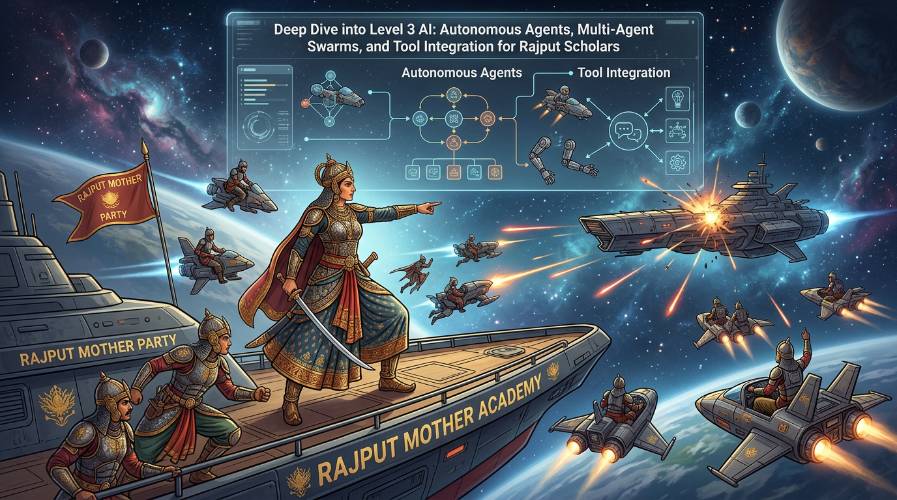
Section 1: Introduction to Level 3 AI — The Era of Autonomous Execution
Artificial Intelligence paradigm shifts are categorized into distinct operational evolutionary levels. While Level 1 AI focused on conversational interactions and basic natural language understanding (e.g., rule-based chatbots), and Level 2 AI introduced advanced cognitive reasoning, contextual problem-solving, and large language model (LLM) processing, Level 3 AI marks the decisive transition into the Era of Autonomous Execution.
EVOLUTION OF AI PARADIGMS
| Level 1: Conversational AI -> Basic NLP & Pattern Matching |
| Level 2: Reasoning AI -> Contextual Problem Solving & LLMs |
| Level 3: Autonomous AI -> Execution, Multi-Agent Swarms & Tools |
Level 3 Autonomous AI Agents do not merely generate text or suggest code; they act independently within defined operational boundaries to achieve complex, multi-step goals. The core architectural leap of Level 3 AI lies in its ability to bridge cognitive reasoning with real-world execution.
Architectural Foundations of Level 3 AI
- Tool Integration & Dynamic API Access: Rather than relying solely on static training weights, Level 3 agents dynamically interface with web search engines, SQL databases, bash terminals, enterprise APIs, and SaaS platforms.
- Persistent Vector Memory: By integrating vector databases, agents maintain long-term semantic memory, past execution logs, and contextual domain knowledge across session boundaries.
- Autonomous Loops: Operating on goal-oriented execution loops (such as ReAct or Plan-and-Solve), agents continuously evaluate their state, synthesize environmental feedback, and refine subsequent steps without human intervention.
- Multi-Agent Collaboration: Orchestrating specialized single-purpose agents into collaborative multi-agent swarms capable of complex task division, code verification, and self-correction.
For Rajput scholars and students at Rajput Mother Academy, mastering Level 3 AI represents a direct path to technological leadership. By transitioning from consumers of AI tools to architects of autonomous agentic systems, scholars can pioneer scalable solutions across academic research, software engineering, and enterprise automation.
Section 2: 3.1 Learning & Education Roadmap for Level 3 AI
To construct robust, enterprise-grade autonomous agents, scholars must acquire deep technical proficiency across three foundational pillars: agentic execution loops, vector memory architectures, and multi-agent swarm orchestration.
The ReAct (Reason + Act) Framework
The ReAct (Reasoning and Acting) paradigm is the cognitive engine driving modern Level 3 agents. Traditional LLM prompting techniques either focus exclusively on chain-of-thought reasoning or direct action execution. ReAct unifies these paradigms into an iterative feedback loop.
| Goal Input |
+————————————————–+
|
v
+——————————-+
| Thought: Cognitive Reasoning |
+——————————-+
|
v
+——————————-+
| Action: External API / Tool |
+——————————-+
|
v
+——————————-+
| Observation: Env Feedback |
+——————————-+
|
v
{ Goal Achieved? }
/ \
NO YES
/ \
v v
(Loop Back to Thought) (Final Output)
The ReAct Execution Loop Step-by-Step
Step 1: Thought
The agent analyzes the user’s objective, breaks down the requirements, checks its execution history, and formulates a strategic hypothesis for the next immediate step.
Step 2: Action
The agent selects a specific external tool (e.g., executing a Python script, querying a vector index, calling a REST endpoint) and formats the precise input payload required.
Step 3: Observation
The external tool executes, returning environmental feedback (e.g., JSON response, code runtime output, database records, error traces) back to the agent’s context window.
Step 4: Iterative Refinement
The agent processes the observation. If the result is incomplete or contains errors, it loops back to Thought to self-correct and execute an alternative Action. If the goal is met, it formats the final response.
Memory Systems & Vector Databases
Autonomous agents require long-term memory to maintain context, retrieve domain-specific data, and avoid repeating past errors. Level 3 architectures achieve this by coupling high-performance embedding models with vector databases.
+——————————————————————–+
| VECTOR MEMORY PIPELINE |
+——————————————————————–+
| Unstructured Data -> Text Embeddings -> Vector Index (Pinecone) |
| | |
| Agent Query -> Semantic Retrieval <——–+ |
+——————————————————————–+
Core Components of Agentic Memory
- Embedding Engines: Models such as OpenAI’s text-embedding-3-large convert unstructured text, code, and documents into high-dimensional vector representations, capturing deep semantic relationships.
- Vector Databases: Infrastructure platforms like Pinecone, ChromaDB, and Qdrant index vector embeddings for low-latency similarity searches (Cosine Similarity, Euclidean Distance, Dot Product).
- Memory Tiers:
- Short-Term Memory: Conversation history maintained in the LLM’s active context window using sliding window techniques.
- Long-Term Memory: Externalized knowledge retrieved dynamically via Vector Search (Retrieval-Augmented Generation / RAG).
- Episodic Memory: Recorded logs of prior agent execution paths, enabling agents to learn from past failures and successes.
Multi-Agent Orchestration & Swarm Intelligence
While single agents excel at isolated workflows, enterprise problems require diverse skill sets. Multi-agent orchestration combines multiple specialized agents into cohesive teams or “swarms.”
Dominant Multi-Agent Orchestration Frameworks
| Framework | Primary Developer | Key Architectural Strength | Ideal Use Case |
| LangGraph | LangChain | Cyclic graph-based control flow, state persistence, fine-grained control | Complex, deterministic stateful workflows |
| CrewAI | Open Source / CrewAI | Role-based delegation, intuitive human-like task management | Rapid deployment of structured team roles |
| Microsoft AutoGen | Microsoft | Event-driven multi-agent conversation, flexible orchestration | Autonomous multi-agent coding and debugging |
Orchestration Patterns
Role-Based Delegation
Each agent is assigned a system persona, background context, specific tools, and explicit boundary rules (e.g., Researcher Agent, Code Writer Agent, Security Auditor Agent).
Sequential Workflows
Tasks pass sequentially through a deterministic pipeline where the output of Agent A serves as the direct input context for Agent B.
Hierarchical & Manager-Led Workflows
A centralized “Manager Agent” breaks down top-level objectives, dynamically assigns sub-tasks to worker agents, reviews work outputs, and requests revisions until quality thresholds are satisfied.
Section 3: 3.2 Top Industry Certifications Pathway (Coursera, IBM, & Microsoft)
To validate technical competence and establish global credibility, Rajput scholars should follow a structured industry certification pathway.
+———————————————————————–+
| CERTIFICATION ROADMAP TIMELINE |
+———————————————————————–+
| Month 1-2: DeepLearning.AI — Functions, Tools & Agents with LangChain |
| Month 3-4: IBM AI Developer Professional Certificate |
| Month 5-6: Microsoft Certified: Azure AI Engineer Associate (AI-102) |
+———————————————————————–+
DeepLearning.AI / Coursera
Course: Functions, Tools and Agents with LangChain (by Andrew Ng)
- Target Audience: Intermediate developers seeking expertise in agentic frameworks.
- Core Curriculum Covered:
- OpenAI Function Calling & Structured Data Extraction.
- Constructing custom tools and binding them to LangChain Expression Language (LCEL).
- Building conversational agents with conversational retrieval networks.
- Transitioning from linear chains to reactive agentic execution engines.
- Preparation Plan: Master Python, async programming, Pydantic data validation, and basic API development prior to enrollment.
IBM AI Developer Professional Certificate
Focus Area: Enterprise Agentic Workflows & Tool-Calling
- Target Audience: Full-stack engineers building enterprise-grade AI software.
- Core Curriculum Covered:
- Building custom RESTful APIs for AI consumption.
- Microservices architecture and containerized deployment (Docker & Kubernetes) for agents.
- Enterprise data integration using IBM watsonx and LangChain.
- Ethical AI deployment, governance, and audit logging for agent operations.
- Practical Project: Building an automated, production-ready enterprise customer resolution agent with database write access.
Microsoft Certified: Azure AI Engineer Associate (AI-102) & AutoGen Credentials
Focus Area: Cloud-Scale Agentic Pipelines & AutoGen Frameworks
- Target Audience: Cloud AI engineers and enterprise solutions architects.
- Core Curriculum Covered:
- Implementing Azure OpenAI Service, Azure AI Search, and Semantic Kernel.
- Architecting multi-agent systems using Microsoft AutoGen.
- Deploying serverless agentic infrastructure using Azure Functions and Container Apps.
- Implementing enterprise security, identity management (Azure AD/Entra ID), and content safety filters.
Step-by-Step Execution Roadmap for Rajput Scholars
+————————————————————————+
| 6-MONTH EXECUTION ROADMAP |
+————————————————————————+
| Phase 1: Months 1-2 | Fundamentals & LangChain Agentic Foundations |
| Phase 2: Months 3-4 | Enterprise Tools, Vector DBs & IBM Track |
| Phase 3: Months 5-6 | Multi-Agent Swarms, Azure AI-102 & Portfolio |
+————————————————————————+
Phase 1: Months 1-2 — Core Foundations & Tool Bindings
- Master Python, asyncio, REST APIs, and vector mathematics.
- Complete DeepLearning.AI Functions, Tools and Agents with LangChain.
- Build 3 single-agent projects using ReAct and custom tools.
Phase 2: Months 3-4 — Memory Infrastructure & Enterprise Integration
- Deep dive into Pinecone, ChromaDB, and Advanced RAG patterns.
- Complete the IBM AI Developer Professional Certificate track.
- Implement production security, rate limiting, and observability using LangSmith.
Phase 3: Months 5-6 — Multi-Agent Swarms & Cloud Certification
- Build multi-agent systems using CrewAI, LangGraph, and AutoGen.
- Pass the Microsoft Certified: Azure AI Engineer Associate (AI-102) exam.
- Publish open-source agentic repositories and build production SaaS MVPs.
Section 4: 3.3 Practical Applications in Education & Rajput Mother Academy
The implementation of Level 3 AI at Rajput Mother Academy can transform traditional education into an adaptive, scalable ecosystem.+——————————————————————–+
| ACADEMIC AGENTIC PIPELINE ARCHITECTURE |
+——————————————————————–+
| [ArXiv/PubMed API] -> [Paper Fetcher Agent] |
| | |
| v |
| [Summarizer Agent] |
| | |
| v |
| [Note Synthesizer] -> [Structured Notes] |
+——————————————————————–+
Automated Research Literature Reviewers
Rajput scholars engaged in higher education and research often face massive volumes of academic literature. An Automated Literature Reviewer Agent streamlines this entire workflow.
Multi-Agent Pipeline Architecture
- Paper Fetcher Agent: Connects via APIs to arXiv, PubMed, and Google Scholar to query papers based on semantic search queries.
- Analysis Agent: Downloads PDFs, parses mathematical equations and methodologies, and extracts key findings.
- Synthesis Agent: Compiles cross-paper comparisons, highlights methodology gaps, and formats structured Markdown notes complete with inline citations.
Sample Python Workflow (CrewAI Framework)

from crewai import Agent, Crew, Process, Task
from crewai_tools import SerperDevTool, WebsiteSearchTool
# Define Specialized Tools
search_tool = SerperDevTool()
web_rag_tool = WebsiteSearchTool()
# Agent 1: Academic Literature Researcher
researcher_agent = Agent(
role=”Lead Academic Literature Researcher”,
goal=”Discover and analyze groundbreaking research papers on {topic}”,
backstory=(
“You are an expert academic researcher skilled in parsing complex papers “
“from arXiv, IEEE, and PubMed. You extract key mathematical formulas and findings.”
),
tools=[search_tool, web_rag_tool],
verbose=True,
memory=True,
)
# Agent 2: Technical Note Synthesizer
synthesizer_agent = Agent(
role=”Senior Academic Synthesizer”,
goal=”Synthesize raw paper summaries into structured, comprehensive literature reviews.”,
backstory=(
“You are a distinguished scholar dedicated to educational excellence at “
“Rajput Mother Academy. You organize complex research into clear summaries.”
),
verbose=True,
)
# Define Tasks
research_task = Task(
description=”Search for the latest 5 papers on {topic}. Extract key methodology, results, and limitations.”,
expected_output=”Detailed raw notes on 5 papers including authors, citations, and key metrics.”,
agent=researcher_agent,
)
synthesis_task = Task(
description=”Compile the research notes into a cohesive Literature Review document with structured sections.”,
expected_output=”A structured markdown literature review with executive summaries and citations.”,
agent=synthesizer_agent,
)
# Assemble Crew
academic_crew = Crew(
agents=[researcher_agent, synthesizer_agent],
tasks=[research_task, synthesis_task],
process=Process.sequential,
)
# Execute System
if __name__ == “__main__”:
result = academic_crew.kickoff(
inputs={“topic”: “Level 3 Autonomous AI Agents in Education”}
)
print(result)
AI-Powered Study Planners & Homework Tracking Agents
To ensure optimal student performance, Level 3 agents can act as 24/7 personalized academic advisors for students at Rajput Mother Academy.
Capabilities of Homework & Study Tracking Agents
- Dynamic Schedule Generation: Reads syllabus files (PDF/ICAL), evaluates student strengths and weaknesses, and generates adaptive study schedules.
- Automated Assignment Submission Validation: Evaluates student code or written submissions against grading rubrics, generating instant diagnostic feedback.
- Automated Escalation & Reminders: Integrates with WhatsApp/Telegram APIs and Google Calendar to send timely study notifications and alert mentors if milestones are missed.
Section 5: 3.4 Practical Applications in Jobs & Global Freelancing
Mastering Level 3 AI unlocks immense opportunities in the global remote work and software engineering landscapes.+——————————————————————-+
| AUTONOMOUS CODING AGENT WORKFLOW |
+——————————————————————-+
| [Issue Logged] -> [Bug Locator] -> [Code Generator] |
| | |
| v |
| [Pull Request] <— [Security Audit] <– [Test Runner] |
+——————————————————————-+
Building Autonomous Coding Agents
Models like Devin, AutoGPT, and OpenDevin demonstrate the power of autonomous coding workflows. Rajput scholars can build customized internal engineering agents for global clients on platforms such as Upwork, Toptal, and GitHub Marketplace.
Key Capabilities of Engineering Agents
- Automated Bug Resolution: Ingests error logs, clones Git repositories, locates faulty functions, writes patches, and executes test suites locally.
- Automated Refactoring & Migration: Translates legacy codebases (e.g., COBOL, Python 2) into modern stack architectures (e.g., Python 3.12, Rust, Go).
- CI/CD Integration: Executes pull request (PR) reviews, verifies unit test coverage, and checks for OWASP security vulnerabilities before code merging.
Automated Customer Support Systems & Financial Data Scraping Agents
Multi-agent swarms excel at processing enterprise data streams in real time.+———————————————————————-+
| REAL-TIME FINANCIAL DATA SWARM ARCHITECTURE |
+———————————————————————-+
| [Market News Feed] -> [Scraper Agent] |
| | |
| v |
| [Sentiment Agent] |
| | |
| v |
| [Quantitative Agent] -> [Trading Alert Executed] |
+———————————————————————-+
Enterprise Use Cases for Global Clients
Multi-Agent Financial Analysis
A network of agents continuously monitors stock market APIs, scrapes SEC filings, parses social sentiment, and runs quantitative risk models to generate automated investment reports.
Multi-Tiered Autonomous Support Networks
- Level 1 Agent: Queries Vector DB knowledge bases to resolve 70% of routine customer tickets instantly.
- Level 2 Agent: Executes actions directly in backend systems (e.g., processing refunds, updating billing data via Stripe APIs).
- Human-in-the-Loop Escalation: Seamlessly routes complex edge cases to human operators with full summary context.
Section 6: 3.5 Institutional Vision & Benefits for Rajput Mother Academy & Students
To position Rajput youth at the forefront of the global AI transformation, Rajput Mother Academy outlines a strategic institutional roadmap focused on technical leadership, innovation, and global competitiveness.+———————————————————————–+
| INSTITUTIONAL STRATEGY |
+———————————————————————–+
| 1. AI Agent Innovation Lab (Dedicated Compute & Research) |
| 2. SaaS Incubator (Student-Led Production Launchpad) |
| 3. Global Freelance Agency Network (High-Value Remote Contracts) |
+———————————————————————–+
Strategic Institutional Initiatives
1. Establishment of the ‘AI Agent Innovation Lab’
Rajput Mother Academy will establish a state-of-the-art research facility equipped with high-performance GPU clusters, cloud credit allocations, and specialized vector memory infrastructure. This lab will serve as a hub for collaborative open-source AI agent engineering.
2. Launching Student-Led AI Agent SaaS Products
Scholars will be guided through ideating, building, deploying, and monetizing specialized AI Agent SaaS products across vertical domain spaces (e.g., Legal Document Parsing, Healthcare Diagnostics Assistants, Automated E-commerce Operations).
3. Global Remote Freelancing & Enterprise Contracting
By mastering LangGraph, AutoGen, and CrewAI, Rajput scholars will secure high-paying global remote roles, launch AI engineering consultancies, and deliver high-impact enterprise solutions to organizations worldwide.
Summary Strategy Matrix
| Initiative | Objective | Target Outcome |
| AI Agent Innovation Lab | Hands-on agentic engineering experience | Production-grade open-source contributions & research publications |
| Industry Certifications | Standardized, globally recognized credentials | 100% certification rate in LangChain, IBM, and Microsoft AI-102 |
| SaaS Incubator | Entrepreneurial product development | Launching high-value AI agent startups by Rajput scholars |
| Global Talent Network | High-value remote freelance contracting | Top-tier placement on global tech platforms and enterprise contracts |
Through this comprehensive academic and technical framework, Rajput Mother Academy guarantees that Rajput scholars transition from passive technology users into world-class architects of Autonomous Level 3 Artificial Intelligence.