
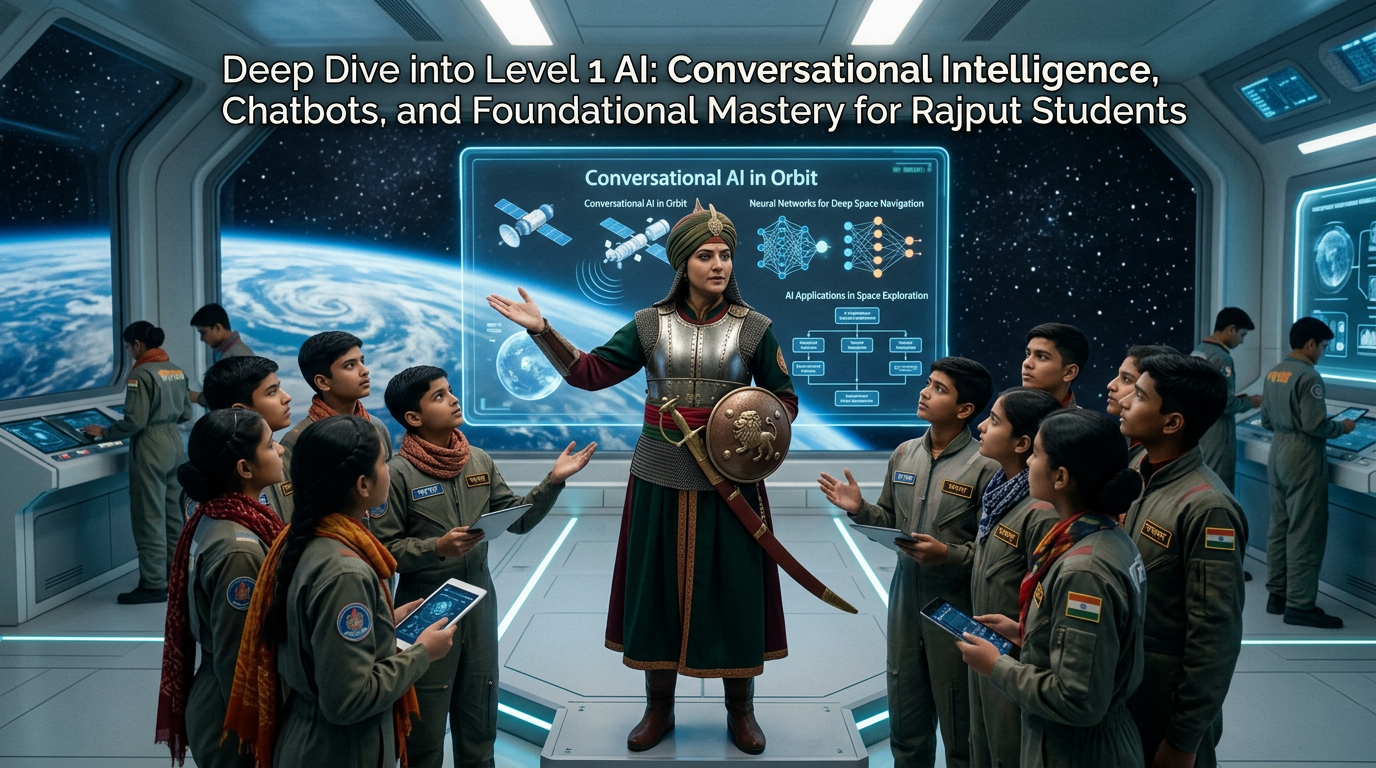
Section 1: Introduction to Level 1 AI
Understanding Conversational Intelligence and Large Language Models
Conversational Intelligence represents the foundational tier of modern artificial intelligence. At its core, Level 1 AI focuses on processing, generating, and refining natural human language through Large Language Models (LLMs). Unlike traditional software programs that operate strictly on explicit, hard-coded rules, LLMs leverage deep learning architectures trained on vast corpora of textual data. This training enables them to understand semantic nuances, contextual syntax, and complex intent behind human communication.
The journey from statistical natural language processing (NLP) to conversational intelligence relies on several key mechanisms:
- Tokenization: The fundamental step where raw text is broken down into smaller units called tokens (words, sub-words, or individual characters). Tokenization allows the AI to map human text into numerical vectors within a multidimensional vector space.
- Vector Embeddings: Mathematical representations of tokens that capture semantic relationships. Words with similar meanings or contextual usage exist closer together in this mathematical space.
- Human-Computer Dialogue Structures: The iterative loop of user prompts, system instructions, context windows, and model completions. This structure allows the AI to maintain state, track dialogue history, and provide relevant, context-aware responses over multi-turn conversations.
The Indispensable Foundation for Rajput Students
As global academic, technological, and economic landscapes rapidly transition into AI-native environments, acquiring early mastery over Level 1 AI becomes a critical imperative. For students at Rajput Mother Academy and across the broader community, foundational AI literacy bridges the gap between traditional educational structures and cutting-edge global opportunities.
Mastering Level 1 AI equips Rajput scholars with crucial advantages:
- Democratized Access to Elite Learning: Interactive AI tools serve as personalized, 24/7 tutors, demystifying complex scientific, mathematical, and historical concepts across multiple languages.
- Cognitive Augmentation: Rather than replacing human thought, Level 1 AI enhances analytical thinking, structured problem-solving, and written articulation.
- Global Competitiveness: Proficiency in human-AI interaction ensures students can seamlessly navigate top-tier higher education institutions and modern knowledge economies worldwide.
Section 2: The Core Mechanics of Conversational Models
Transformers and Attention Mechanisms
Modern conversational AI rests entirely upon the Transformer architecture, introduced by researchers in 2017. Prior to Transformers, language models processed text sequentially—word by word—which often resulted in catastrophic forgetting over long sentences or paragraphs.+———————————————————————–+
| INPUT TOKENS (Text) |
|—|
|
v
+———————————————————————–+
| POS-ENCODED EMBEDDINGS |
+———————————————————————–+
|
v
+———————————————————————–+
| MULTI-HEAD SELF-ATTENTION |
| (Calculates relative weight & context between ALL tokens at once) |
+———————————————————————–+
|
v
+———————————————————————–+
| FEED-FORWARD NETWORK (FFN) |
+———————————————————————–+
|
v
+———————————————————————–+
| PROBABILITY DISTRIBUTION |
| (Predict Next Token/Word) |
+———————————————————————–+
Self-Attention Mechanism
The self-attention mechanism allows an LLM to evaluate the relative importance of every word in a sequence concerning every other word, regardless of their distance. For example, in the sentence “The scholar referenced the historical text because it contained vital insights,” the attention mechanism dynamically links the pronoun “it” back to “text” rather than “scholar”.
Contextual vs. Word-by-Word Processing
By processing entire sequences in parallel rather than sequentially, Transformers capture subtle contextual shifts, stylistic tones, and complex logical relationships across large text spans, enabling coherent multi-paragraph generation.
Prompt Engineering as a Cognitive Tool
Prompt engineering is the art and science of structuring input text to guide conversational AI toward optimal, highly relevant outputs. It transforms passive AI usage into a dynamic cognitive instrument.
Zero-Shot Prompting
Asking the model to perform a task without prior examples.
- Example: “Translate the following passage into Sanskrit: ‘Knowledge is the true strength of a scholar.'”
Few-Shot Prompting
Providing a few explicit input-output examples within the prompt to establish clear patterns before requesting the final output.
- Example:
- Input: “Physics -> Study of matter and energy”
- Input: “Botany -> Study of plant life”
- Input: “Histology -> “
- Output: “Study of microscopic anatomy of biological tissues”
Persona Assignment
Instructing the AI to adopt a specific identity, expert perspective, or behavioral archetype to tailor the tone, depth, and vocabulary of the response.
- Example: “Act as a senior professor of quantum mechanics. Explain Heisenberg’s Uncertainty Principle to a first-year undergraduate student using clear analogies.”
Constraint Formatting
Setting explicit boundaries regarding format, length, style, and excluded terms to maintain high precision.
- Example: “Summarize the attached article in exactly 3 bullet points. Each bullet point must not exceed 15 words. Do not use jargon.”
Managing Hallucinations and Output Accuracy
LLMs operate on probabilistic text generation, meaning they predict the most likely next token based on training patterns. Consequently, they can occasionally produce incorrect facts presented with high confidence—a phenomenon known as hallucination.
Fact-Checking and Grounding
To maintain precision, students must adopt rigorous verification workflows:
- Source Grounding: Requiring the model to generate answers only using explicitly provided reference text.
- Chain-of-Thought (CoT) Prompting: Instructing the model to “think step-by-step” before delivering a final answer, which significantly reduces logical errors.
Temperature Settings
Temperature controls the randomness of an LLM’s output:
- Low Temperature (0.0 – 0.3): Highly deterministic, precise, and focused. Ideal for coding, mathematics, and factual summaries.
- Medium Temperature (0.4 – 0.7): Balanced synthesis and standard drafting.
- High Temperature (0.8 – 1.0+): Highly creative, diverse, and novel text generation; higher risk of factual inaccuracies.
Section 3: Step-by-Step Learning and Educational Roadmap
| Phase | Core Objective | Key Skills Acquired | Target Deliverable |
| Phase 1 | Basic Conversational Interaction | Context management, basic queries, tone adjustments | Multi-turn interview simulation |
| Phase 2 | Intermediate Prompt Crafting | Few-shot prompting, document synthesis, constraint handling | Structured textbook chapter summary |
| Phase 3 | Custom Knowledge Integration | Retrieval-Augmented Generation (RAG) basics, system prompts | Specialized personal study assistant |
| Phase 4 | No-Code Deployment | API connections, webhook configuration, UI integration | Academy support chatbot |
Phase 1: Basic Conversational Interaction and Context Windows
- Objective: Understand prompt-response dynamics and manage context window limits.
- Key Tasks: Practice multi-turn conversations, observe how context decays over long threads, and learn to re-ground the conversation by periodically providing fresh summaries of previous inputs.
Phase 2: Intermediate Prompt Crafting and Document Summarization
- Objective: Master advanced prompt structures to process large bodies of information efficiently.
- Key Tasks: Input complex academic essays or historical documents and use role-based, constrained prompts to extract executive summaries, thematic matrices, and key definitions.
Phase 3: Custom GPT and Personal Knowledge Base Integration
- Objective: Build tailored AI instances pre-loaded with custom reference materials.
- Key Tasks: Configure custom system instructions, upload syllabus documents, and construct a personal AI tutor optimized for specific subject tracks (e.g., Physics, History, Literature).
Phase 4: Basic API Connection and No-Code Chatbot Deployment
- Objective: Transition from consumer web interfaces to deploying functional conversational tools.
- Key Tasks: Obtain API keys, utilize no-code platform builders (e.g., Zapier Interfaces, Voiceflow, BuildShip), and deploy an interactive study assistant to a web page.
Section 4: Essential Industry Certifications for Level 1 Mastery and Eligibility Criteria
Top Level 1 Certifications Overview
DeepLearning.AI: ChatGPT Prompt Engineering for Developers
- Focus: Practical prompt architecture, iterative prompt development, and programmatic LLM API usage.
- Key Skills: Inferring, transforming, expanding, and summarizing text using API parameters.
Google AI Essentials
- Focus: Core concepts of generative AI, practical productivity workflows, and ethical usage principles.
- Key Skills: Prompt crafting, responsible AI assessment, workplace automation integration.
Microsoft Certified: Azure AI Fundamentals (AI-900)
- Focus: Fundamental concepts of artificial intelligence, machine learning, and conversational AI services on Azure.
- Key Skills: Azure Bot Service, Language Understanding (LUIS), and ethical AI frameworks.
Preparation Guide for Rajput Students
[Step 1: Foundational Study]
Read documentation & take free introductory courses (1-2 weeks)
|
v
[Step 2: Practical Lab Work]
Build 3 prompt projects & maintain a prompt notebook (2-3 weeks)
|
v
[Step 3: Practice Assessments]
Complete practice exams & review missed concepts (1 week)
|
v
[Step 4: Formal Certification Exam]
Schedule & clear certification test
Step 1: Foundational Study
Dedicate 1 to 2 weeks reviewing core documentation and free interactive modules provided by deeplearning.ai and Microsoft Learn.
Step 2: Practical Lab Work
Apply concepts practically by building three distinct projects:
- A custom study guide generator.
- An automated document proofreader.
- A persona-driven interview preparation tool.
Step 3: Practice Assessments
Attempt timed practice tests to familiarize yourself with scenario-based questions regarding model selection, temperature tuning, and safety guardrails.
Step 4: Formal Certification Exam
Schedule and clear the chosen certification exam, adding verified credentials to professional profiles like LinkedIn.
Section 5: Practical Applications in Academic Education and Competitive Exams
Study Material Generation for Competitive Exams
Competitive examinations such as JEE, NEET, CUET, and Civil Services demand rigorous concept retention and systematic review routines.
Generating Custom Study Guides
Students can leverage structured prompts to transform lengthy textbook chapters into clear, high-yield study notes.
- Prompt Pattern: “Convert the following text on Electrostatics into a 3-part study guide: 1. Core Principles, 2. Key Formulas with variable definitions, 3. Top 5 common conceptual traps.”
Automated Flashcard Creation
Generate active-recall flashcard decks compatible with spaced-repetition platforms like Anki.
- Prompt Pattern: “Format the following notes on Indian Constitutional Amendments into a two-column CSV table: Column 1 = Front (Question/Concept), Column 2 = Back (Answer/Detail).”
Mnemonic Generation for High-Volume Memorization
Create creative mnemonics to retain complex taxonomies, chemical sequences, or historical timelines.
Multilingual Translation and Localization
Translating technical and scientific material into regional languages often introduces challenges with jargon and accuracy.
Context-Aware Localization
Rather than relying on literal, word-for-word translation, Level 1 AI enables semantic localization:
- Regional Adaptation: Translating advanced technical concepts into Hindi or regional dialects while retaining standard international technical terms in English script (code-switching).
- Classical Language Translation: Converting historical and philosophical literature between Classical Sanskrit, English, and modern regional languages with detailed commentary on linguistic root words.
Section 6: Career Acceleration and Job Market Integration
Resume Tailoring, Interview Preparation, and Service Automation
Precision Resume Alignment
Students can analyze job descriptions alongside their current resumes to identify gap areas and rephrase achievements using strong impact verbs.
- Workflow: Input the targeted job description and request the AI to highlight missing keywords, restructure bullet points around quantifiable outcomes, and optimize formatting for Applicant Tracking Systems (ATS).
Interactive Interview Simulations
Simulate real-time behavioral and technical interviews.
- Execution:System: “You are an expert technical interviewer at a tier-1 software firm. Interview me for a Junior Data Analyst role. Ask one question at a time. Wait for my response before asking the next question. Provide constructive feedback at the end.”
Customer Service and Workflow Automation
Understand how companies utilize conversational agents for automated ticketing, lead qualification, and customer support, preparing students for roles as prompt engineers, chatbot managers, and AI operations specialists.
Freelance and Remote Career Pathways
The rapid adoption of AI has created high-demand remote freelance roles that students can fulfill alongside their studies:
- Conversational Content Curation: Refining AI-generated copy for marketing, technical documentation, and educational modules.
- Dataset Annotation and Evaluation: Auditing AI outputs for quality control, factual accuracy, safety adherence, and alignment with human intent.
- Prompt Engineering Consulting: Helping small-to-medium enterprises (SMEs) design customized prompt libraries to automate internal administrative tasks.
Section 7: Institutional Benefits for Rajput Mother Academy and Students
Deploying Academy-Branded Student Helpdesks
By adopting Level 1 AI frameworks, Rajput Mother Academy can construct an institution-wide conversational support system:
24/7 Administrative and Academic Assistance
- Instant Query Resolution: Students receive immediate responses to queries regarding class schedules, exam syllabi, library resources, and administrative deadlines.
- Scalable Admissions Support: Prospective students and parents can interact with an intelligent academy chatbot that guides them through admission criteria, scholarship applications, and campus facilities.
Personalized Learning Interventions
Integrated helpdesks track common student queries, providing faculty members with aggregated analytics on topics where students experience the most difficulty. This data allows teachers to adapt classroom instruction accordingly.
Standardizing Digital Literacy Across Scholars and Faculty
To maximize the impact of AI technologies, Rajput Mother Academy can establish a unified institutional framework for digital empowerment.
Institutional AI Framework
RAJPUT MOTHER ACADEMY
AI LITERACY HUB
|
+————————-+————————-+
| |
v v
FACULTY EMPOWERMENT STUDENT MASTERY
• Automated Grading Assistants • Level 1 AI Certifications
• Curriculum Enrichment • Ethical AI Guidelines
• Interactive Lesson Design • Competitive Exam Prep
Faculty Empowerment Workshops
Training educators to design interactive lesson plans, generate dynamic classroom quizzes, and leverage AI assistants to streamline administrative workload, freeing up time for direct student mentorship.
Standardized Student Literacy Benchmarks
Integrating Level 1 AI mastery modules directly into the academy’s standard curriculum. Every graduating scholar gains verified practical skills in prompt engineering, critical source verification, and conversational tool deployment, establishing Rajput Mother Academy as a leading center for modern tech-empowered education.
Eligibility Criteria and Target Demographics
To ensure broad accessibility across diverse academic and professional backgrounds, Level 1 AI certifications and courses maintain inclusive entry standards designed to maximize participation.
Qualification Requirements
- Minimum Educational Background: Open to High School / Senior Secondary Students (10+2 enrolled or completed), Undergraduate Students across all streams, Postgraduates, and Working Professionals.
- Prerequisites: No prior coding or computer science background required. Basic functional literacy in English/Hindi and fundamental computer operational skills are sufficient.
Age Criteria
- Minimum Age: 13–15 years (with parental/institutional guidance via Rajput Mother Academy).
- Ideal Age Group: 16 to 35+ years for academic competitive exam aspirants, university students, and job seekers.
- Maximum Age: No upper age limit; lifelong learning open to all scholars and faculty members.
Eligible Academic Streams & Professional Branches
- Engineering & Technology: Computer Science (CS), Information Technology (IT), Artificial Intelligence & Data Science (AI/DS), Electronics & Communication (ECE), Electrical (EEE), Mechanical, Civil.
- Pure & Applied Sciences: Physics, Chemistry, Mathematics, Statistics, Biotechnology, Environmental Science.
- Commerce & Management: B.Com, BBA, MBA, Finance, Accounting, Marketing, Supply Chain Management.
- Humanities & Social Sciences: BA/MA in History, Political Science, English Literature, Sociology, Law (LL.B / LL.M), Public Administration.
- Competitive Exam Aspirants: Scholars preparing for UPSC Civil Services, State PSCs, JEE, NEET, CUET, Banking (IBPS/SBI), and SSC exams.