
Abstract
Undergraduate medical education in India operates under a standardized, unified evaluation paradigm governed by statutory healthcare and testing bodies. This study examines the institutional architecture, merit-based selection mechanics, and strategic imperatives for aspirants seeking admission to MBBS, BDS, and allied medical sciences across central, state, and deemed universities.
Institutional Framework and Admission Pathways
1. National Standardization Paradigm
Under Section 14 of the National Medical Commission (NMC) Act, the National Eligibility cum Entrance Test (NEET-UG) serves as the sole, non-negotiable entrance test for medical university admissions nationwide. Individual university-level written examinations have been legally phased out to maintain an equitable, transparent merit evaluation matrix.
2. Dual-Channel Centralized Allocation
Subsequent to score normalization by the National Testing Agency (NTA), seat allocation is bifurcated into two legal frameworks:
- All India Quota (AIQ – 15%): Administered by the Medical Counselling Committee (MCC) for all state government medical colleges, alongside 100% seat allocation for Central Universities, AIIMS, JIPMER, and Deemed Medical Institutions.
- State Domicile Quota (85%): Managed by respective State Directorate of Medical Education (DME) authorities based on domicile regulations and state-level merit rank lists.
Core Competency & Preparation Strategy
Admission to premier medical universities mandates rigorous conceptual mastery across core scientific disciplines:
- Biomedical Sciences (50% Weightage): In-depth analytical comprehension of Botany and Zoology, emphasizing cell biology, human physiology, and genetics.
- Chemical & Physical Sciences (50% Weightage): Problem-solving speed in Organic Synthesis, Physical Chemistry thermodynamics, and Physics mechanics/electrodynamics.
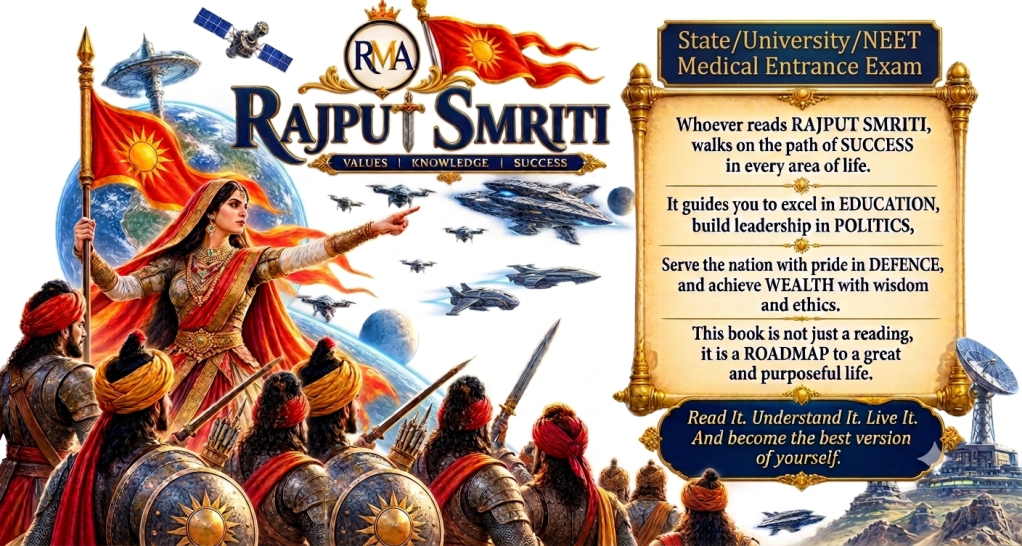
At Rajput Mother Academy, we cultivate academic discipline, rigorous mock analysis, and systematic time management to empower students to secure merit seats in top-tier medical universities.
| Field | Details |
| Document Type | Admission Entrance Exam |
| Sector ID | EDU / UG Medical |
| Sector | Higher Education |
| Sub-Sector | Medical & Healthcare Sciences (MBBS, BDS, BAMS, BHMS, BSMS, BUMS, BVSc & AH) |
| Institute Type | National Entrance Examination |
| Govt Type | Central / State / Deemed / Private Universities & Institutes of National Importance (AIIMS, JIPMER, BHU, AMU) |
| PVT Student Admission | Yes – mandatory single-window examination for all private medical/dental colleges |
| Abroad Admission | Yes – mandatory qualification score required for Indian students pursuing MBBS abroad (as per NMC guidelines) |
| Category | National Testing Agency (NTA) & Medical Counselling Committee (MCC) / State CET Authorities |
| Qualification | Higher Secondary (10+2 / HSC) with Physics, Chemistry, Biology/Biotechnology & English (Min 50% aggregate for UR, 40% for SC/ST/OBC, 45% for PwD) |
| Country | India |
| Authority | National Testing Agency (NTA) for Exam; Medical Counselling Committee (MCC) & State Counselling Authorities for Seats |
| Entrance Exam | National Eligibility cum Entrance Test (NEET-UG) |
| Entrance Exam Subjects | Physics, Chemistry, Botany, and Zoology (320–720 marks total distribution) |
| Counselling Authority | MCC (15% All India Quota, Deemed, Central Varsities, AIIMS, JIPMER) & State Directorate of Medical Education (85% State Quota) |
| Admission Process | NEET-UG Exam → NTA Merit List & All India Rank (AIR) → MCC / State Counselling Registration → Choice Filling → Seat Allotment & Medical Fitness Verification |
| Reservation Policy | Government of India Central Reservation Policy (15% AIQ & Central Institutes) / State-Specific Reservation Rules (85% State Quota) |
| Approx. Total Seats | ~105,000–110,000+ MBBS seats (~200,000+ total including BDS, AYUSH, and Veterinary across India) |
| Open (UR) Seats | ~42,000 – 45,000 seats (~40–45% of total government/central intake) |
| EWS Seats | ~10,500 – 11,000 seats (~10% reserved seats in government & central institutions) |
| OBC-NCL Seats | ~28,000 – 29,500 seats (~27% reserved seats in central list institutions & government colleges) |
| SC Seats | ~15,500 – 16,500 seats (~15% reserved seats in government institutions) |
| ST Seats | ~7,800 – 8,200 seats (~7.5% reserved seats in government institutions) |
| Open-PwD Seats | ~2,100 – 2,250 seats (5% horizontal reservation within Open category) |
| EWS-PwD Seats | ~525 – 550 seats (5% horizontal reservation within EWS category) |
| Female Supernumerary Seats | Institute/State-specific (≈ 1–5% in select state medical colleges and institutional quotas) |
| Sports Quota | State/Institute-specific (≈ 1,000–2,000 seats / 1–3% in state medical counselling) |
| NCC Quota | State-specific (≈ 500–1,000 seats / ~1% reserved seats in select states) |
| Defence Quota | State/Central specific (e.g., Wards of Armed Forces Personnel / AFMC Pune selection priority) |
| NRI Quota | ~15,000+ seats (≈ 15% reserved seats in private and deemed medical universities) |
| Management Quota | Strictly 0% in Government Colleges; ~35,000+ seats (≈ 35–50% available in private self-financing medical colleges) |
| Tuition Fees (General) | ₹10,000 to ₹1,00,000/year (Govt/AIIMS); ₹10,00,000 to ₹25,00,000/year (Private/Deemed Universities) |
| Tuition Fees (EWS) | Subsidized rates in Government Colleges / Post-Matric and State Fee Reimbursement Schemes applicable |
| Hostel Fees (General & EWS) | ₹5,000 to ₹30,000/year (Govt Medical Colleges); ₹1,00,000 to ₹3,50,000/year (Private/Deemed Campuses) |
| Other Charges | NTA Application Fee (₹1,700 for General, ₹1,600 for OBC-NCL/EWS, ₹1,000 for SC/ST/PwD), MCC refundable security deposit, clinical charges |
| Scholarships Available (General & EWS) | Central Sector Scheme of Top Class Education, NSP Scholarships, State EBC Fee Concessions, MHRD/UGC Grants |
| Application Mode | Online (via NTA Portal) |
| Notification Month | January–February |
| Application Month | February–March |
| Entrance Exam Month | First Sunday of May |
| Counselling Month | July–September (MCC AIQ & State Quota Multi-Round Counselling) |
| Classes Start | September–October |
| Official Website | neet.nta.nic.in / mcc.nic.in |
| Placement Opportunities | High / Guaranteed Residency – Mandatory Internship followed by compulsory Govt Rural Service / Post-Graduation |
| Career Opportunities | Medical Officer (MO), General Physician, Resident Doctor, Civil Services (CMS), Healthcare Administrator, Medical Researcher |
| Higher Study Options | NEET-PG / INI-CET (MD, MS, DNB), Super Specialization (DM, M.Ch via NEET-SS), USMLE, PLAB, MRCP |
| Remarks | NEET-UG is the sole legal entrance exam for medical/dental admissions across India. Due to high competition, top government medical colleges (like AIIMS New Delhi, MAMC, KGMU, JIPMER) demand near-perfect percentile scores (~680–715+ out of 720 for General category). |


Leave a comment