
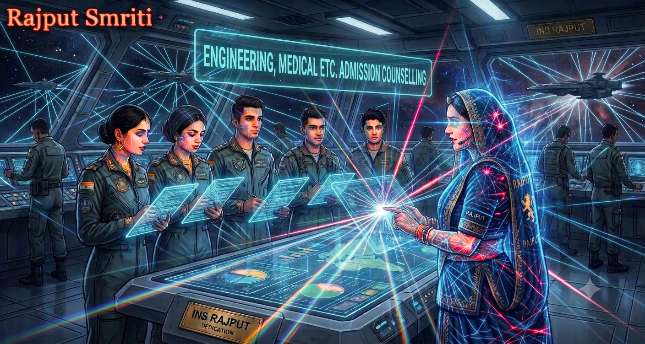
A Introduction message for Rajput Students
Education is the foundation of individual success and community development. Many capable Rajput students possess the intelligence, determination, and potential to excel in competitive examinations, higher education, and professional careers. However, talent alone is not sufficient. Timely information, proper guidance, financial support, and continuous encouragement from families are equally important for academic success.
One of the major challenges faced by many students is not a lack of ability but a lack of awareness. Information about admissions, scholarships, entrance examinations, government recruitment, internships, and career opportunities often reaches students too late or not at all. As a result, many eligible candidates miss important application deadlines and lose valuable opportunities before the competition even begins.
Financial constraints and the absence of professional career guidance further increase these difficulties. Some parents, despite their best intentions, may not be familiar with the rapidly changing educational system, digital application processes, or the wide range of career options now available. Consequently, students may hesitate to apply for competitive examinations or admissions because they lack confidence, information, or support.
Admission and recruitment processes are highly competitive, with seats and vacancies distributed according to the applicable laws, regulations, and reservation policies of the concerned institutions and governments. Regardless of the category under which a student applies, the number of available opportunities is limited, making early preparation, accurate information, and timely application essential for success.
Rajput Mother Academy envisions addressing these challenges by creating a reliable educational information network that provides authentic admission updates, scholarship notifications, examination calendars, career counselling, mentorship, and digital learning resources. The objective is to ensure that every Rajput student receives the right information at the right time and is encouraged to apply for every opportunity for which they are eligible.
The future of the Rajput community depends not only on talent but also on awareness, preparation, and access to opportunities. Every student deserves the chance to compete with confidence. By strengthening information, guidance, parental awareness, and educational support, we can help more Rajput students transform their potential into achievement and contribute meaningfully to society.
“When every eligible student receives the right information at the right time, opportunity becomes achievement, and achievement becomes the foundation of community progress.”
Abstract
Education has evolved from the traditional transfer of knowledge to a comprehensive process of intellectual, ethical, and professional development. This theoretical paper introduces two conceptual models—the Education Room and the Education Laser Teacher—as complementary components of a learner-centered educational ecosystem. The Education Room represents the physical and psychological environment that supports disciplined learning, whereas the Education Laser Teacher symbolizes precision mentoring focused on the unique learning trajectory of every student. Together, these concepts provide a framework for enhancing academic performance, career readiness, and lifelong learning among Rajput students.
Chapter 1: Introduction
Education is widely recognized as a catalyst for social mobility, economic progress, and human development. However, educational success depends not only on curriculum and assessment but also on the quality of the learning environment and the effectiveness of instructional guidance.
This paper proposes that sustainable educational excellence requires the integration of two essential dimensions:
- A structured learning environment (Education Room).
- A focused mentoring system (Education Laser Teacher).
The interaction between these dimensions forms a holistic educational model capable of producing academically competent, ethically responsible, and professionally successful individuals.
Chapter 2: Theoretical Foundation
Learning theories emphasize that knowledge acquisition is influenced by environmental, cognitive, motivational, and social variables. Learning is therefore viewed as an interaction between the learner, the educational environment, and instructional facilitation.
Within this framework:
- The Education Room functions as the environmental variable.
- The Education Laser Teacher functions as the instructional variable.
- The student serves as the central cognitive agent.
- Educational achievement represents the measurable outcome.
The proposed model assumes that improvements in learning conditions and instructional precision positively influence academic performance.
Chapter 3: The Education Room Theory: A Long-Term Educational Investment for Future Generations
The Education Room should be regarded as the most valuable educational asset within every household. Unlike other parts of a house that may be renovated or redesigned according to changing lifestyles, an Education Room should be planned as a permanent and enduring space capable of serving multiple generations. Ideally, its structural foundation should be designed for longevity—lasting several centuries with appropriate maintenance—while components such as doors, windows, furniture, electrical systems, digital infrastructure, and learning technologies should be upgraded periodically to meet future educational requirements.
Parents often invest substantial financial resources in constructing luxurious kitchens, large bedrooms, decorative living rooms, or aesthetically attractive houses. Although these spaces contribute to family comfort, they do not directly influence a child’s intellectual development to the same extent as a well-designed learning environment. Education Room should receive equal or higher priority than luxury home features
From an educational perspective, every family should prioritize the establishment of a strong, secure, safe, and technologically advanced Education Room. The quality of this room should be determined not by luxury but by its ability to support continuous learning, concentration, creativity, safety, and academic excellence.
The design of an Education Room should include:
- A distraction-free study environment.
- Adequate natural and artificial lighting.
- Proper ventilation and ergonomic furniture.
- Secure storage for books and learning materials.
- High-speed digital connectivity.
- Computers or digital learning devices.
- Access to online educational resources.
- Facilities for virtual classrooms and competitive examination preparation.
- Backup power and internet connectivity wherever feasible.
- A quiet and psychologically supportive atmosphere that encourages disciplined learning.
The Education Room should become the academic centre of the household. Children should use this room every day for focused study, reading, research, revision, skill development, and educational planning. Short periods of rest between study sessions may also be beneficial to maintain concentration and cognitive efficiency.
However, academic development should always be balanced with physical well-being. Children should regularly participate in physical exercise, outdoor activities, and preferably individual sports such as athletics, swimming, badminton, table tennis, cycling, yoga, martial arts, or running. These activities contribute to physical fitness, mental resilience, emotional stability, and improved learning performance.
The increasing complexity of modern education, rapid technological advancement, competitive entrance examinations, and the expanding digital learning ecosystem make a dedicated Education Room increasingly important. Furthermore, such a room can also serve as a safe and secure environment where children can study with minimal distractions and greater protection during emergencies or adverse circumstances.
The establishment of an Education Room should not be viewed as an expense but as a long-term educational investment in future generations. Every family, irrespective of its financial capacity, can develop an Education Room according to its available resources. The objective is not to create the most expensive room but to create the most effective learning environment possible within the family’s means.
The guiding principle of the Education Room Theory is simple:
“The strength of a nation’s future depends not only on the houses it builds but on the learning environments it creates within those houses.”
Accordingly, Rajput Mother Academy advocates that every family should prioritize the creation of an Education Room as an essential component of child development, educational achievement, and lifelong learning. A well-planned Education Room is not merely a physical space—it is an investment in knowledge, character, innovation, and the future of generations to come.
One academic suggestion: instead of stating that parents “should not make a good kitchen or bedroom,” it is stronger and more balanced to say that education should receive equal or higher priority than luxury home features. This makes the argument more persuasive and appropriate for scholarly writing while avoiding an absolute claim that could weaken the thesis.
Chapter 4: Education Laser Teacher (ELT): A Conceptual AI Framework for Personalized Learning.
The Education Laser Teacher (ELT) is a visionary educational concept proposed as a future learning system in which every Rajput student has access to an intelligent, personalized, and interactive virtual teacher. The long-term objective of this concept is to ensure that quality educational guidance is available to every learner, regardless of geographical location, economic background, or access to conventional classroom instruction.
The Education Laser Teacher is conceived as an Artificial Intelligence (AI)-based educational assistant that becomes available whenever a learner activates a computer, tablet, mobile device, smart television, or other digital learning platform. The system would appear as an interactive virtual teacher displayed on a smart screen, digital blackboard, holographic display, or future visualization technology. Its primary purpose would be to simulate the experience of learning from a knowledgeable and supportive human teacher.
Unlike conventional digital learning applications that primarily deliver recorded content, the Education Laser Teacher would provide dynamic, two-way interaction with students. It would explain concepts, answer questions, adapt explanations according to the learner’s level of understanding, and continuously monitor learning progress.
A distinguishing characteristic of the Education Laser Teacher is instructional personalization. The system would maintain multiple teaching methodologies for every subject and topic, allowing the learner to select the instructional style that best matches individual learning preferences. For example, a mathematical concept could be explained through numerical illustrations, graphical representations, practical applications, animations, historical development, or real-life case studies. Similarly, scientific, social science, language, and professional subjects could be presented through multiple pedagogical approaches to improve conceptual understanding.
The visual representation of the Education Laser Teacher would also be customizable. Learners could select the appearance of the virtual teacher according to their comfort and motivation. The interface may represent a male or female teacher or adopt the visual characteristics of a parent, mentor, educator, or other fictional educational avatar designed specifically for learning. Appropriate clothing styles, languages, communication styles, voice characteristics, and cultural preferences could also be selected to create a familiar and engaging educational environment. Such personalization aims to strengthen learner engagement while maintaining professional educational standards.
The Education Laser Teacher would function as a comprehensive academic mentor capable of supporting learners throughout their educational journey. Its responsibilities would include:
- Explaining academic concepts with clarity and precision.
- Providing multiple examples for every topic.
- Solving textbook and application-based problems.
- Generating practice exercises with step-by-step solutions.
- Preparing students for school, board, university, and competitive examinations.
- Explaining previous examination questions and expected answer-writing techniques.
- Conducting continuous assessments and providing personalized feedback.
- Supporting critical thinking, analytical reasoning, and problem-solving skills.
- Recommending additional learning resources according to individual progress.
In addition to curriculum-based education, the Education Laser Teacher could assist learners in developing digital literacy and responsible online behaviour. Students would be able to ask questions related to educational content encountered on social media platforms, online discussions, or digital news sources. The system would distinguish verified academic information from misinformation, explain concepts using reliable evidence, and encourage responsible digital citizenship.
The Education Laser Teacher is therefore envisioned not merely as a software application but as a lifelong intelligent learning companion capable of adapting to the changing educational needs of every student. By integrating artificial intelligence, personalized instruction, adaptive assessment, multilingual communication, and interactive learning technologies, this model seeks to democratize access to high-quality education.
Within the educational philosophy of Rajput Mother Academy, the Education Laser Teacher represents a future-oriented vision in which advanced technology complements, rather than replaces, human teachers. Human educators continue to provide emotional support, ethical guidance, mentorship, and values, while the Education Laser Teacher expands educational accessibility through continuous, personalized, and technology-enabled learning opportunities.
Ultimately, the Education Laser Teacher aspires to ensure that every Rajput student has access to a knowledgeable, patient, and personalized educational guide available whenever learning is needed, thereby supporting academic excellence, lifelong learning, and equal educational opportunity.
Chapter 5: Educational Interaction Model
The theoretical interaction may be expressed conceptually as:
Learning Achievement = f (Learning Environment × Precision Mentoring × Student Motivation × Academic Discipline)
Where:
- Learning Environment represents the Education Room.
- Precision Mentoring represents the Education Laser Teacher.
- Student Motivation represents intrinsic learning behaviour.
- Academic Discipline represents consistency of educational practice.
The model predicts that improvements in any component strengthen overall educational outcomes.
Chapter 6: Educational Philosophy
The proposed framework is founded upon five philosophical principles:
Environmental Learning Principle
Students perform more effectively when exposed to organized educational environments.
Precision Guidance Principle
Targeted instructional interventions are more effective than generalized teaching methods.
Continuous Improvement Principle
Academic excellence emerges through consistent refinement rather than isolated achievement.
Learner Responsibility Principle
Students remain active participants in constructing their own knowledge.
Ethical Education Principle
Education should cultivate character, integrity, responsibility, and social leadership alongside academic competence.
Chapter 7: Educational Implications
The proposed framework has practical implications for educational institutions, families, mentors, and community organizations.
Educational institutions may establish structured learning centres.
Parents may create dedicated study environments within homes.
Teachers may adopt individualized mentoring approaches.
Senior professionals may provide career guidance and educational mentorship.
Community organizations may facilitate scholarship awareness, academic counselling, and professional networking.
Together, these initiatives contribute to sustainable educational development.
Chapter 8: Rajput Mother Academy Model
Rajput Mother Academy may implement this theoretical framework through five integrated educational pillars:
- Academic Information Repository.
- Career Guidance and Counselling.
- Scholarship Awareness Platform.
- Competitive Examination Support.
- Mentor–Student Knowledge Network.
These pillars collectively establish an educational ecosystem capable of supporting students from secondary education through higher professional education.
Chapter 9: Discussion
The Education Room and Education Laser Teacher are conceptual constructs rather than institutional mandates.
Their significance lies in emphasizing that educational excellence depends simultaneously upon environmental quality and instructional precision.
While traditional education frequently emphasizes curriculum completion, the proposed framework prioritizes learner development, cognitive engagement, and individualized educational growth.
Future empirical studies may evaluate the effectiveness of this framework across different educational settings and demographic groups.
Chapter 10: Conclusion
The Education Room provides the structural foundation for disciplined learning, while the Education Laser Teacher provides the intellectual direction necessary for personalized academic development.
Together, these concepts constitute a theoretical framework capable of strengthening educational achievement, professional preparedness, and ethical leadership.
For Rajput Mother Academy, this model represents not merely an educational philosophy, but a long-term vision dedicated to empowering every Rajput student through knowledge, discipline, mentorship, and lifelong learning.


Leave a comment