
Abstract
To address the critical deficit in academic and professional guidance experienced by Rajput youth over the past two decades, this paper establishes a clear, non-commercial roadmap for securing employment in the global maritime sector. Entry into the Merchant Navy offers a viable pathway toward financial stability and professional growth. This study outlines the core eligibility criteria, regulatory frameworks, examination pathways, mandatory certifications, and financial realities necessary for aspirants to successfully navigate admission, training, and vessel placement without falling victim to industry scams.
I. Statutory Criteria and Examination Pathways
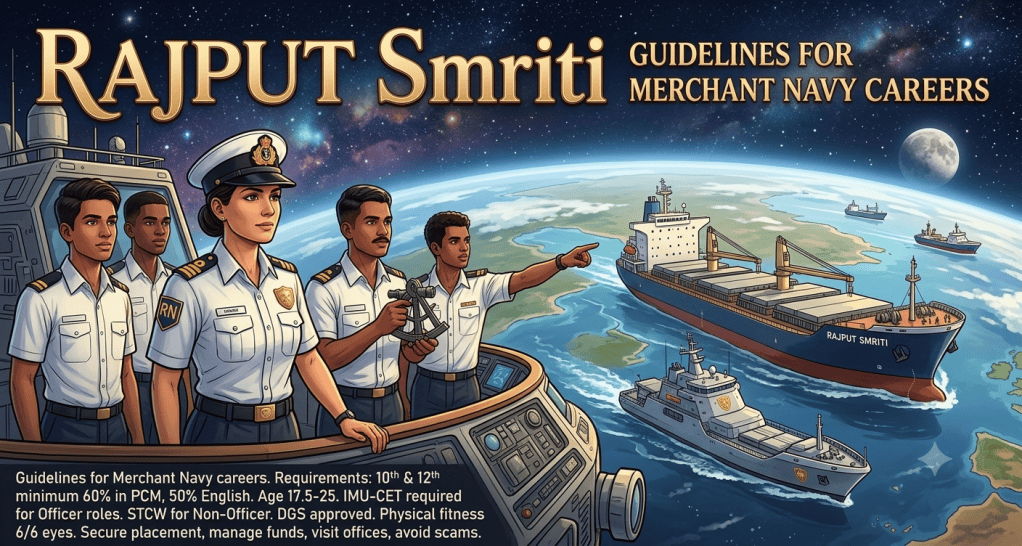
Pursuing a career at sea requires specific age parameters, academic benchmarks, and physical standards set by maritime governing bodies.
- Age Profile: Applicants must be between 17.5 and 25 years of age at the time of course commencement.
- Academic Benchmarks: Candidates must secure a minimum of 60% aggregate marks in Physics, Chemistry, and Mathematics (PCM), alongside at least 50% in English in both 10th and 12th standard examinations.
- Physical & Medical Standards: Candidates must meet strict physical fitness requirements, including an uncorrected or corrected visual acuity of 6/6 in both eyes, alongside complete color-vision compliance.
- Officer Entry (IMU-CET): Aspirants seeking Officer-grade roles (such as B.Sc. in Nautical Science, Marine Engineering, or Diploma in Nautical Science) must clear the Indian Maritime University Common Entrance Test (IMU-CET), a national-level competitive examination.
- Non-Officer Entry (STCW Certification): Students completing 10th or 12th standard who wish to enter Non-Officer ratings do not require IMU-CET scores. Instead, they must complete mandatory Safety Training, Certification and Watchkeeping (STCW) courses, which remain valid for 5 years before requiring re-validation.
II. Regulatory Oversight and Scam Avoidance
Due to the prevalence of fraudulent recruitment agencies targeting rural and uninformed students, candidates must strictly adhere to verified government channels throughout their application process.
- Directorate General of Shipping (DGS): The official Directorate General of Shipping website serves as the ultimate authority for maritime laws, approved training institutes, accredited recruitment agencies, and statutory guidelines.
- Physical Verification: Applicants must physically visit training centers and shipping company offices to verify credentials prior to submitting documents or paying fees.
- Sponsorship Directives: Securing an official sponsorship letter from a recognized shipping company prior to training guarantees sea-time training slots and post-course placement, eliminating reliance on unverified middle-men.
III. Financial Planning and Career Execution Strategy
Maritime training and placement involve significant upfront capital expenditure. A clear understanding of financial requirements prevents sudden dropouts and ensures smooth progression from training to shipboard placement.
- Capital Allocation: Aspirants must prepare dedicated financial arrangements to cover institute course fees, medical tests, STCW certifications, travel, passport/CDC documentation, and legitimate consultancy processing fees.
- Structured Progression Strategy:
- Application & Selection: Fulfill age/academic criteria and clear entrance exams or sponsorship interviews.
- Training Completion: Complete pre-sea training at a DGS-approved maritime institute.
- Sponsorship & Sea-Time: Fulfill mandatory onboard training requirements under a sponsored shipping line.
- Consultancy & Placement: Engage only with licensed Recruitment and Placement Services (RPSL) agencies when seeking direct employment placements.
Conclusion
By combining rigorous preparation for the IMU-CET, mandatory STCW certification, physical fitness, and direct verification through the Directorate General of Shipping, Rajput aspirants can systematically enter the Merchant Navy. Transparent financial planning and vigilance against recruitment fraud ensure a sustainable, lucrative maritime career.


Leave a comment